
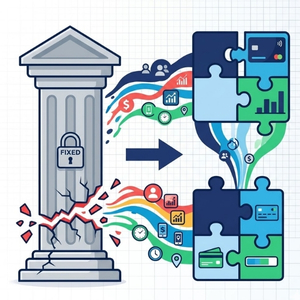
The Product Is Not Dying.
The Fixed Product Is.
Banks have spent decades building products first, then finding customers to fill them. Data is ending that model. What comes next is banking that moves with you.
A savings account pays the same rate whether you earn $400 a month or $40,000. A loan carries the same terms whether you have never missed a payment or you have missed six. A credit card limit stays fixed whether you are three months into a salary increase or three months from redundancy. This is the fixed product. And it is running out of logic.
For most of modern banking, this model made sense. Banks did not have enough data to do anything better. They grouped customers into broad segments and built products for the middle of each group. Most customers got something that partially fit. Nobody got something that actually fit.
That is changing. Not because banks decided to change. Because the data did.
What the Data Now Reveals
Four streams of customer data are now usable in ways they were not five years ago. Together, they give a financial institution a picture of a customer that no fixed product was ever designed to serve.
- Age, income range, location
- Job type, family structure
- Life stage and household profile
- Salary patterns, bill payments
- Merchant spend and loan history
- Cash flow cycles and surplus timing
- App usage and search intent
- Failed transactions and support history
- Channel preference and session depth
- Time of day and device type
- Location and life event signals
- Business cycle and seasonality
None of these categories is new. Banks have held versions of this data for years. What is new is the ability to read all four streams together, in real time, and act on what they say within seconds.
McKinsey calls the result “hyperpersonalized” banking. Personalisation leaders in financial services grow revenue four times faster than laggards. Younger customers now expect experiences calibrated to their behaviour, not their segment. AI systems process all four data streams continuously to shape every product interaction: the limit, the rate, the timing, the channel, the offer. Not once at onboarding. Every time a customer touches the bank.
“The old model says: here is our product. Do you qualify? The new model says: based on your data, here is the financial service that fits you now.”
What Replaces the Old Model
L.E.K. Consulting frames this shift as moving from product-led banking to customer-centric banking. The distinction is not semantic. It changes everything a bank has to do.
In a product-led bank, a team designs a loan product, sets fixed terms, defines the eligible customer, and pushes it through branches and apps. The customer either qualifies or does not. The bank either wins the customer or loses them.
In a customer-centric bank, the product is configurable. The same underlying credit facility shows up differently depending on who is looking at it. A gig worker with a volatile income sees one offer. A salaried employee with a three-year repayment record sees another. A small merchant whose sales have grown 40 percent in six months sees a third. Each person sees the product that their data says they should see.
Concretely, this means:
- A loan limit based on real cash flow, not a fixed income bracket
- A savings plan built around actual spending habits and surplus patterns
- An insurance cover triggered by a travel booking, a health event, or a device purchase
- A merchant credit offer calculated from point-of-sale revenue history
- A credit card limit that adjusts automatically with salary, risk score, and repayment behaviour
- A remittance price set by corridor demand, transaction urgency, and wallet preference
The categories remain familiar: loan, card, savings, insurance, wallet. What changes is that every variable inside those categories now moves.
The Infrastructure Behind This
The Financial Brand documents a clear pattern: most banks want to deliver personalised experiences, and most banks stall. The reason is almost always the same. Data is siloed across business lines. Core systems cannot process in real time. Product teams do not share data with credit teams. The aspiration is customer-centric. The architecture is still product-led.
KPMG’s 2026 financial services technology report identifies the foundations that separate institutions making progress from those stuck at aspirations. The list is unglamorous but exact:
- Clean, unified customer data across all business lines
- Real-time transaction processing capability
- Customer data platforms that consolidate all four data streams
- Modern core banking systems with open API architecture
- AI models with explainability layers for credit and risk
- Consent management and data governance frameworks
- Cybersecurity architecture that protects behavioural inference
- Compliance controls built into the personalisation layer
This list matters because it reframes the problem. Hyper-personalisation is not a product decision or a marketing decision. It is an infrastructure decision. Banks that want to deliver it have to build differently, not just think differently.
For African banks, the infrastructure gap is real but not insurmountable. Newer core banking deployments, open banking regulation in markets like Nigeria and Kenya, and the growing quality of mobile transaction data mean several African institutions are closer to this capability than their legacy peers in Europe or North America.
The Risk Nobody Wants to Name
Hyper-personalisation can be predatory. The same data that lets a bank offer a lower rate to a reliable customer can let a bank charge a higher rate to a vulnerable one. The same system that identifies a customer’s life event to offer relevant insurance can exploit that event to push an unsuitable product at a premium price.
These risks are not theoretical. A personalisation system without governance can produce any of these outcomes:
The response is not to abandon personalisation. It is to build it with explainability, consent, and compliance as first-order requirements, not afterthoughts. A credit decision must be explainable. Data collection must be consented to. A pricing model must be auditable. These are not nice-to-haves. In most markets they are legal obligations. In all markets they are the conditions for trust.
TechTarget notes that the architecture should separate customer identity from behavioural inference. A bank can know how a customer behaves without storing that behaviour against their identity in a way that creates discriminatory feedback loops. That separation is a technical decision with ethical consequences.
Where the Competitive Advantage Actually Lives
Every bank will eventually have access to similar data. AI models are not proprietary for long. The data streams that power personalisation are becoming standard infrastructure.
The competitive advantage does not come from the data or the model. It comes from three things that are harder to replicate:
A customer who believes their bank uses data responsibly will share more data. More data produces better personalisation. Better personalisation deepens the relationship. The loop compounds. Trust is the input that makes everything else more valuable.
The difference between a good personalised offer and a missed one is often minutes. A bank that processes a salary credit, identifies a relevant savings opportunity, and surfaces an offer before the customer finishes their morning coffee wins the moment. Three days later does not.
AI systems can surface an offer. They cannot always judge whether this customer, at this moment, should receive it. A bank needs human judgment layered over its personalisation systems. Institutions that get this balance right will outperform those that hand the decision entirely to the model.
The Bottom Line
The winning bank will not have the biggest product catalogue. It will have the deepest understanding of each customer, the infrastructure to act on that understanding in real time, and the governance to do it without losing trust.
That is what adaptive financial services means. Not more products. The right service, for the right person, at the right moment.
Every bank in Africa has customers whose financial lives this model could materially improve. The only question is whether their systems and their leadership are ready to build toward it.
The product catalogue is no longer the moat. Data, real-time decisioning, and trust are. Banks that adapt will keep customers. Banks that wait will keep complaints.