
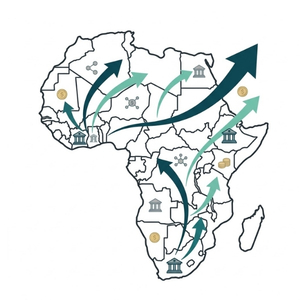
How Africa’s Banks Are Racing Across the Continent
Expansion playbooks from East, South, West, and North Africa
In 2015, Equity Group walked into the Democratic Republic of Congo. Six out of every hundred Congolese held a bank account. Ten years later, the DRC business is Equity’s second biggest profit engine after Kenya. In the third quarter of 2025 alone, it delivered Kshs 17.7 billion (about 137 million US dollars) in pre-tax profits, up 18 percent year on year.
One statistic. One decade. The clearest signal yet of what is happening across African finance.
A continental land grab is underway. The banks leading it come from four regional traditions. Each runs a different playbook. The deals of the past three years show how wide those differences have grown.
The Big Picture
South African banks with operations beyond their home market have grown faster than those that stayed home. That lesson now drives strategy across the continent.
Three forces are reshaping where banks expand and how fast.
Domestic markets are maturing. South Africa is the clearest example. Its banking sector has absorbed a decade of weak GDP growth averaging 0.7 percent.
European lenders are pulling back. Local banks captured an estimated 12 percent revenue rise in 2025 by stepping into the gap. French banks have exited fastest, especially across Francophone Africa.
Trade integration is accelerating. The African Continental Free Trade Area will lift African incomes by 7 percent, or 450 billion US dollars, by 2035. Banks with cross-border networks will finance that trade. Banks that move early will win the mandates.
East Africa: Proximity, Inclusion, and Patient Depth
East African banks expand by regional adjacency. They move out from Kenya into Uganda, Tanzania, Rwanda, South Sudan, and the DRC because the trade corridors are familiar and customer behaviour is known. The model is simple. Build first. Scale second. Push financial inclusion to the mass market.
Equity Group: Patient Capital in Underserved Markets
Equity’s strategy is the clearest expression of the inclusion thesis. The bank enters markets with very low banking penetration. It then replicates the model it built in Kenya over three decades: agent networks, mobile banking, SME lending, and development finance.
The footprint now spans Kenya, Rwanda, Tanzania, Uganda, South Sudan, and the DRC, with a Commercial Representative Office in Ethiopia. The network covers 402 branches, more than 896 ATMs, and a vast agent and merchant base. Equity is now a systemic bank in five of the six markets it operates in.
The DRC is the clearest proof of what this model can produce. When Equity entered in 2015, only 6 percent of the population had bank accounts. The bank brought 30 years of Kenyan operating experience into a market with almost no formal financial infrastructure.
That patience paid off. Equity BCDC is now the group’s second biggest contributor to revenues and profits after Kenya. For the year to December 2024, regional operations made up 49 percent of total assets and 54 percent of pre-tax profit. The home market is no longer the primary engine.
Rwanda showed the template at work. Equity signed a share purchase agreement for Cogebanque in July 2023 and closed the deal in November of that year, with 99.125 percent of issued share capital. Cogebanque and Equity Bank Rwanda merged on 31 December 2023. The combined entity became Rwanda’s second largest bank, with 46 branches, 59 ATMs, 4,516 agents, and 1,777 merchants. The pattern is repeatable: acquire, merge, rebrand, scale.
Tanzania is the next push. Equity plans to channel up to 20 million US dollars into its Dar es Salaam unit.
Ethiopia is the long game. Equity has been on the ground for seven years through a representative office, studying the market while Addis Ababa moves slowly toward opening its banking sector. With more than 120 million people and persistently low banking penetration, Ethiopia is the continent’s biggest untapped retail banking opportunity.
KCB Group: Acquisitions to Build Share Fast
KCB covers similar geography to Equity but leans harder on acquisitions to gain market share quickly.
The bank operates in Uganda, Tanzania, Rwanda, Burundi, South Sudan, and the DRC. Non-Kenyan subsidiaries delivered 30.7 percent of pre-tax profit and 30.5 percent of the group balance sheet.
Rwanda set the model. KCB acquired Banque Populaire du Rwanda from Atlas Mara and merged it with its existing subsidiary to form BPR Bank Rwanda. The deal turned KCB from a subscale challenger into a major player overnight.
DRC followed the same logic. KCB took 85 percent of Trust Merchant Bank at 1.49 times book value. TMB was the third largest bank by assets in the country at the time.
KCB then recycled capital. After selling the National Bank of Kenya to Access Bank for Sh14.2 billion, the bank announced plans to inject up to Sh4 billion into its Tanzania unit. KCB Tanzania generated 48.6 million dollars in revenue and 20 million dollars in net profit in 2024, making it the third most profitable external subsidiary after DRC and Rwanda. KCB ranks tenth in Tanzania today and is pushing for a top-five position.
CEO Paul Russo has been direct on the rationale: Tanzania borders 11 countries and sits at the heart of the Lobito Corridor, the new transit route for mineral-rich landlocked markets.
Both Equity and KCB have joined the Pan-African Payment and Settlement System, positioning to clear cross-border trade transactions in local currency.
West Africa: Acquisitions as the Primary Engine
Access Bank: Continental Scale Through Serial Buying
Access Bank runs the most acquisition-heavy strategy of any African bank today. Buy market access. Integrate. Use the group’s capital base and technology to tie the network together.
The bank now serves more than 60 million customers in 24 markets across three continents, through over 700 branches and service outlets. Its operations span Nigeria, Ghana, Rwanda, Zambia, Mozambique, Botswana, and the DRC. Branches in London and the UAE and representative offices in China, Lebanon, India, Paris, and Hong Kong extend its reach beyond Africa.
East Africa has been the main battlefield. In Tanzania, Access executed three transactions back to back. The bank completed its acquisition of African Banking Corporation Tanzania on 11 June 2024. BancABC’s operations were then folded into Standard Chartered Tanzania’s Consumer, Private, and Business Banking units to form Access Bank Tanzania. By June 2025, the Standard Chartered piece had closed. Access Bank Tanzania now operates through 936 Access Wakala agents and 98 BancEasy Satellite outlets.
In Kenya, Access completed the acquisition of National Bank of Kenya from KCB Group, with all regulatory approvals secured in both Kenya and Nigeria. NBK became a wholly owned subsidiary. The deal grew Access Bank’s Kenyan branch network from 23 branches in 12 counties to 77 branches in 28 counties.
Uganda was the warning shot. Access announced a deal to acquire 80 percent of Finance Trust Bank in January 2024. The transaction collapsed nearly two years later. Despite competition clearance from East African regulators and cooperation from Ugandan authorities, the deal failed to secure all required approvals in time. Finance Trust Bank later transitioned from a Tier I commercial bank to a Tier II credit institution as a result of capitalisation issues. Access Bank’s Uganda entry is still incomplete.
Outside East Africa, Access Holdings entered a binding agreement with South Africa’s Bidvest Group to acquire 100 percent of Bidvest Bank Holdings for around ZAR 2.3 billion (approximately 122 million dollars). The deal extends the group into South African retail banking.
Access Bank’s model rests on two pillars: Nigerian domestic earnings cross-subsidise entry costs in new markets, while the group’s trade finance and cross-border payment infrastructure generates early revenue in each new country.
Ecobank: The Federated Pan-African Model
Ecobank sits in a category of its own. It was not born in a large domestic market that funded continental expansion. It was built as a pan-African institution from the start.
Founded in 1985 by the Federation of West African Chambers of Commerce, Ecobank now operates in 33 African countries, more than any other bank.
The strategy rests on what the group calls its Network Advantage. The infrastructure is the product. No single country dominates. The value lies in the connections between all of them.
The results show through. Net profits rose 29 percent in 2025 to 689.3 million dollars, from 534 million dollars in 2024. Total assets grew 14 percent to 35.8 billion dollars. Francophone and Anglophone West Africa supply the bulk of profits today. Central, Eastern, and Southern Africa and Nigeria are the next growth phase.
The risks are governance and capital coordination across so wide a footprint. Ecobank has weathered governance crises and recurring currency volatility across West Africa. The bank centralises treasury, compliance, and technology while keeping country leadership locally anchored.
South Africa: Big Balance Sheets and a Shift to East Africa
South African banks bring the continent’s largest balance sheets to the table. They have historically favoured Southern African Development Community markets with established regulatory ties and currency links. The events of 2025 and 2026 signal a clear shift toward East Africa.
Standard Bank, FirstRand, Absa, and Nedbank now hold presence across multiple African countries. Standard Bank’s revenue from African markets has climbed from 20 percent of total revenue in 2014 to 39 percent in 2023.
Standard Bank: The Long-Term Operator
Standard Bank has been the most consistent long-term pan-African operator from South Africa. It leads with Corporate and Investment Banking, building relationships with governments, infrastructure developers, and large corporates before developing retail banking. The inverse of Equity’s approach.
African subsidiaries now contribute 44 percent of group headline earnings. For the year to December 2024, the rest-of-Africa portfolio delivered about 18 billion rand in headline earnings on revenue just under 60 billion rand. The bank operates in 20 African countries.
Standard Bank has named Kenya, Tanzania, Ethiopia, Uganda, and Rwanda as its key East African markets. Its partnership with ICBC of China provides a Chinese-African trade finance edge no other African bank holds.
Nedbank: From Passive Investor to Active Acquirer
Nedbank’s story is the sharpest lesson in the difference between minority investment and operational control.
Nedbank recorded a 7 billion rand cumulative loss on its Ecobank Transnational position, due to foreign exchange volatility and restricted dividend visibility. The lender received 1.8 billion rand in exit proceeds after originally investing 6.3 billion rand in 2014.
That experience reshaped the NCBA deal structure. Nedbank is no longer buying minority stakes. It is buying control.
The structure tells you what changed. The consideration is 20 percent cash and 80 percent Nedbank shares listed on the JSE. Cash drain is minimised. NCBA shareholders gain Nedbank balance sheet exposure. NCBA stays independently governed and keeps its brand, local leadership, and NSE listing. Nedbank currently runs only a representative office in Kenya, so no operational integration is required on day one.
The NCBA acquisition is not the end goal. It is the launchpad for further expansion into Ethiopia and the DRC. NCBA also brings digital banking operations in Ghana and Cote d’Ivoire, giving Nedbank instant exposure to two West African markets through digital platforms, without the need for physical entry.
Absa: Reorganising for Pan-African Execution
Absa has underperformed its South African peers on continental expansion. CEO Kenny Fihla is rebuilding the bank around a pan-African operating model.
In 2025, Absa created a consolidated Personal and Private Banking unit. The three core businesses, Personal and Private Banking, Business Banking, and Corporate and Investment Banking, now operate on a pan-African basis. The Africa Regions business contributes about a third of group earnings and is growing faster than the South African operation.
Absa Uganda has agreed to acquire Standard Chartered Bank Uganda’s Wealth and Retail Banking business, with integration planned for Q4 2026. Fihla has also poached two senior executives from Standard Bank to lead the new strategy. The message is unmistakable. Absa is moving from South Africa-centric to genuinely pan-African.
FirstRand: Disciplined, Patient, and Strong
FirstRand is the most financially disciplined of the South African banks. It does not chase breadth. It targets markets where it can deploy the FNB digital platform and produce superior returns on equity.
FirstRand plans to extend its reach across Africa through strategic acquisitions in markets where it is already present. East Africa, particularly Kenya, is under active consideration.
The numbers explain the patience. FirstRand entered 2026 valued at around 510 billion rand, with a return on equity of 20.2 percent, normalised earnings of 41.8 billion rand, and a cost-to-income ratio of 50.8 percent. CEO Mary Vilakazi has signalled openness to non-bank acquisitions, including digital financial services that would not require a full banking licence.
North Africa: The Francophone Corridor Play
Attijariwafa and Morocco’s Banking Giants
North African banks, led by Morocco’s Attijariwafa Bank and Banque Centrale Populaire, run a different logic. Their primary corridor is Francophone West and Central Africa. Language, civil law, currency zones (WAEMU and CEMAC), and longstanding commercial ties give them structural advantages no Anglophone bank can easily match.
Attijariwafa Bank now operates in over 25 countries with total assets valued at 95 billion dollars. Its 2025 initiatives included cross-border payment platforms and customised Islamic banking products for African consumers and businesses. Bank of Africa BMCE operates in 18 other African countries.
Moroccan banks have benefited directly from the French retreat. Banque Centrale Populaire and Attijariwafa are expanding aggressively across Francophone West Africa, with credit growth accelerating in lower-risk segments.
Attijariwafa positions itself as the dominant financial player across the Maghreb, WAEMU, and CEMAC currency zones. It uses established North-South trade flows, strong Moroccan diaspora ties, and corporate banking relationships to anchor in each market before scaling retail services.
Egypt’s CIB: Targeted Sub-Saharan Entry
Commercial International Bank of Egypt has taken a more selective southern approach. CIB bought 51 percent of Kenya’s Mayfair Bank in April 2020 for 35 million dollars. It bought the remaining 49 percent in January 2023 for 40 million dollars, renaming the unit CIB Kenya. Kenya is now CIB’s primary sub-Saharan gateway, used to build trade finance ties between Egyptian and East African corporates in agriculture, energy, and infrastructure.
Five Playbooks Compared
The differences between these regional models are not tactical. They reflect distinct competitive advantages, capital structures, regulatory relationships, and customer bases.
Lead product. East African banks lead with retail banking and inclusion. South African banks lead with CIB, infrastructure finance, and trade. Access Bank combines retail acquisition with trade corridor development. Moroccan banks anchor on commercial banking and Francophone trade finance.
Entry method. Equity enters early into low-penetration markets and grows organically, with selective acquisitions like Cogebanque in Rwanda. KCB uses acquisitions to buy immediate share, then injects capital to accelerate growth. Access Bank relies on acquisitions everywhere. Nedbank now demands controlling stakes, not minority positions. Standard Bank and Absa expand by deepening existing operations, with bolt-on retail acquisitions like Standard Chartered’s Uganda business. Ecobank built organically from scratch in 33 markets over four decades.
Capital source. Nigerian banks fund expansion from domestic profits and capital markets. Access Bank ran a rights issue in 2024, raising NGN 351 billion (256.6 million dollars), and became the first Nigerian lender to meet new capital requirements ahead of the March 2026 deadline. South African banks use JSE-listed equity as acquisition currency, as Nedbank did in the NCBA deal where 80 percent of the consideration is shares. Moroccan banks draw on Moroccan sovereign and institutional capital.
Target market profile. East African banks prioritise population size and low banking penetration. DRC, Tanzania, and Ethiopia fit exactly. South African banks target financial depth, regulatory stability, and trade corridor positioning, with Kenya at the top of the list. Moroccan banks target Francophone cultural and legal alignment. Access Bank targets any market that adds customer count and trade flows.
Risk tolerance. Equity and KCB have operated in South Sudan and the DRC through active conflict. In DRC, KCB had to close 14 branches in the east due to unrest. South African banks are more selective on political volatility, preferring markets with predictable central bank oversight.
Key vulnerability. Access Bank’s acquisition-led model carries integration risk and regulatory complexity in many jurisdictions at once. The collapsed Uganda Finance Trust Bank deal shows that even well-resourced banks can lose years to failed transactions. Equity’s organic inclusion model demands long payback periods. The DRC took close to a decade to become a top earner. Nedbank’s minority investment in Ecobank destroyed capital. That error is now reshaping how Nedbank structures every deal.
The Key Battlegrounds in 2025 and Beyond
Kenya is now the most contested banking market on the continent. Access Bank acquired the National Bank of Kenya in 2025. Nedbank announced its offer for around 66 percent of NCBA Group. Standard Bank, FirstRand, and Absa are all eyeing Kenya as constrained South African growth pushes them outward. Higher Kenyan minimum capital requirements are forcing smaller lenders to seek strategic partners or merge, opening a rare consolidation window.
DRC is the single largest untapped retail market in East-Central Africa. Account ownership rose from 17 percent in 2014 to 39 percent in 2024. Equity BCDC and KCB’s TMB are now established. Ecobank and Access Bank run digital platforms. The market will attract more entrants as EAC integration matures.
Tanzania is taking simultaneous capital injections from Equity and KCB while Access has built a single entity from three acquisitions. Tanzania’s economy grew 5.4 percent in 2024, outpacing Kenya’s 4.7 percent. Regional lenders cite the country’s economic outlook and its place on the Lobito Corridor rail project.
Ethiopia is the long game for everyone. Regulatory changes in late 2024 and early 2025 opened the sector to foreign banks for the first time. Equity, KCB, and Nedbank have all named Ethiopia as a priority. More than 120 million people. Very low banking penetration. A generational opportunity.
The Underlying Pattern
There is no single African banking expansion model. The winning strategy depends on corridors, regulation, language, capital, customer behaviour, and the bank’s own operating strength.
East African banks expand through proximity and inclusion. West African banks expand through acquisitions, capital, and scale. South African banks expand through corporate clients, infrastructure, and selective retail platforms. North African banks expand through Francophone corridors and regional integration. Pan-African banks like Ecobank expand through network reach and cross-border utility.
The AfCFTA is set to unlock 450 billion dollars in intra-African trade by 2035. Banks are positioning to finance that wave. Digital innovation and regional payment systems are bypassing foreign exchange constraints by clearing trades in local currency.
The banks that can serve trade flows across borders, run a consistent digital platform across markets, and absorb regulatory complexity in many jurisdictions at once will define African banking for the next generation.
The race is fully underway. And it is picking up speed.
FinHive Africa is a B2B banking technology and financial intelligence platform covering African banking, payments, fintech, and financial infrastructure. Visit finhive.africa for more.
Finhive Insights · Banking & Markets · May 2026