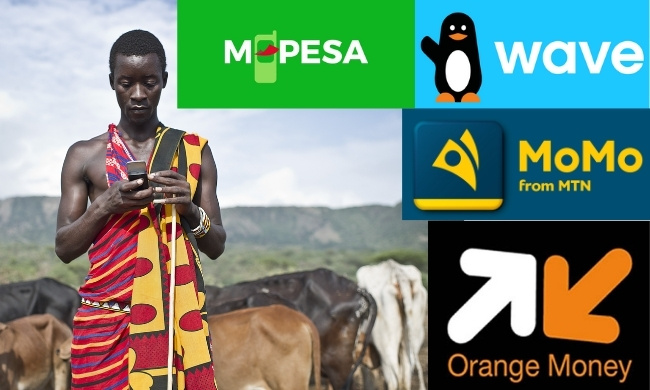
Mobile money has fundamentally reshaped financial access across Africa. From urban centers to remote rural communities, millions of people now rely on their phones to send money, pay bills, save, and access credit. Behind this transformation are powerful digital wallet platforms that enable speed, scale, and reliability.
In this article, we spotlight five of Africa’s leading mobile money services and the wallet platforms that power their success: M-Pesa, MTN MoMo, Orange Money, Airtel Money, and Wave.
1. M-Pesa – Powered by Huawei’s Mobile Money Platform
Launched in 2007 by Safaricom, part of the Vodafone Group, M-Pesa is Africa’s most iconic mobile money service and one of the earliest pioneers of mobile financial services globally. What began in Kenya has since expanded across multiple markets, including Tanzania, Mozambique, the Democratic Republic of Congo, Lesotho, Ghana, and Egypt, among others.
By 2021, M-Pesa had grown to more than 50 million monthly active users across Africa, cementing its position as the continent’s largest and most influential fintech platform. Supporting this scale required a technology backbone capable of handling massive transaction volumes with high reliability.
In 2015, Safaricom migrated M-Pesa to Huawei’s Mobile Money Platform in a landmark move often described as “bringing M-Pesa home.” The transition successfully migrated 12.8 million Kenyan users overnight to Huawei’s open, high performance system without service disruption. This upgrade enabled faster transaction processing, greater system stability, and the flexibility to introduce new services at scale.
Today, M-Pesa processes enormous transaction volumes, handling approximately €63 billion in transactions in a single quarter during 2021. Beyond basic person to person transfers, the platform now supports merchant payments through Lipa na M-Pesa, as well as savings, loans, and other financial services. All of this runs on a robust Huawei powered infrastructure that continues to underpin M-Pesa’s role as a cornerstone of financial inclusion across Africa.
2. MTN MoMo – Powered by Ericsson’s Wallet Platform
MTN Mobile Money, branded as MoMo, is Africa’s other mobile money heavyweight and a cornerstone of the continent’s digital finance ecosystem. Operated by MTN Group, Africa’s largest telecommunications company, MoMo was launched in 2009 and has since expanded rapidly across the continent.
Today, MTN MoMo is available in 16 African countries, including major markets such as Nigeria, Ghana, Uganda, and Côte d’Ivoire. The platform serves more than 63 million active users who rely on MoMo for everyday financial needs ranging from peer to peer transfers and merchant payments to banking services and digital commerce.
At the heart of MoMo’s scale and reliability is the Ericsson Wallet Platform, which MTN has used for years as its core mobile money infrastructure. Built for security, resilience, and high transaction throughput, the Ericsson platform supports everything from basic money transfers to more advanced services such as digital loans, micro insurance, and cross border remittances within the MoMo ecosystem.
3. Orange Money – In-House Platform by Orange S.A.
Launched in 2008 by French telecommunications group Orange S.A., Orange Money has grown into one of Africa’s most prominent mobile money services, particularly across francophone West and Central Africa. The service now operates in 17 countries spanning Africa and the Middle East, including key markets such as Côte d’Ivoire, Senegal, Mali, Burkina Faso, and Cameroon.
As of the latest figures, Orange Money serves approximately 49 million active customers, reflecting its deep penetration in markets where Orange holds a strong mobile network presence. This scale has been achieved through a strategy that differs markedly from other mobile money leaders.
Unlike platforms such as M-Pesa and MTN MoMo, Orange developed and continues to operate its mobile wallet platform entirely in-house. Owned and maintained by Orange S.A., this approach allows the company to tightly integrate mobile money services with its telecom infrastructure while tailoring functionality to the specific regulatory, economic, and consumer needs of each market.
The results speak to the strength of this model. In 2024 alone, Orange Money facilitated more than €160 billion in transactions across its operating footprint. Customers rely on the platform for a broad range of everyday financial services, including person to person transfers, bill payments, savings, and micro lending, accessed through both simple USSD interfaces and the Orange Money smartphone app.
Operating its own wallet platform has also enabled Orange to innovate rapidly. A notable example is the integration with Orange Bank Africa, which allows users to access digital lending and banking services directly within the Orange Money ecosystem. This in-house control further enables Orange to roll out new features and updates consistently across multiple markets with speed and operational efficiency.
Backed by a trusted brand and extensive mobile network reach, Orange Money continues to advance financial inclusion across its markets, powered by a technology platform fully owned and operated within the Orange Group.
This technology partnership has played a critical role in MoMo’s explosive growth. Annual transaction value on the platform nearly tripled from USD 76 billion in 2018 to approximately USD 204 billion in 2022, reflecting both rising user adoption and expanding use cases. As part of MTN’s Ambition 2025 strategy, the group is doubling down on fintech, positioning MoMo as a central driver of future growth beyond traditional telecom services.
Ericsson’s wallet platform further strengthens this strategy through its support for open APIs, including dedicated Open API frameworks in select markets. These capabilities allow third parties and developers to integrate services, extend functionality, and build new financial products on top of the MoMo platform. This openness not only accelerates innovation but also reinforces MTN’s mission to deepen financial inclusion across Africa.
Today, MTN MoMo stands alongside M-Pesa as one of Africa’s most influential mobile money platforms, underpinned by a proven and scalable technology foundation that continues to support its rapid evolution.
4. Airtel Money – In-House Platform by Bharti Airtel
Airtel Money is the mobile money service of Bharti Airtel’s African operations and has rapidly emerged as a top tier player in the continent’s digital finance landscape. Operating across 14 African countries, including Kenya, Uganda, Tanzania, Nigeria, and Zambia, Airtel Money now serves over 50 million users across the region.
From the outset, Airtel developed its mobile wallet platform internally, drawing on the group’s deep expertise in telecommunications and digital services. Managed in-house through Airtel Africa, this approach has given the company strong control over product design, market customization, and operational execution. It has also enabled tight integration between Airtel Money and Airtel’s core telecom offerings, often allowing customers to access mobile connectivity and financial services through a single, unified application.
This strategy has translated into strong commercial performance. By mid 2025, Airtel Money’s annualized transaction value had reached approximately USD 193 billion, representing year on year growth of around 36 percent. These volumes place Airtel Money just behind M-Pesa and MTN MoMo, firmly establishing it as one of Africa’s “big three” mobile money platforms.
To support continued expansion, Airtel has recently embarked on a major technology upgrade, deploying a new cloud based wallet platform in partnership with Comviva. This modernization is designed to further enhance scalability, resilience, and feature velocity as transaction volumes and service complexity continue to grow.
By retaining ownership of its platform while investing in next generation infrastructure, Airtel is positioning Airtel Money as a comprehensive digital financial ecosystem. From everyday transfers and merchant payments to microloans and advanced financial services, Airtel Money continues to evolve under the Airtel umbrella as a key driver of financial inclusion across Africa.
5. Wave – Built In House by Wave (Fintech Startup)
Wave stands apart from Africa’s leading mobile money services as the only major player not operated by a traditional telecommunications group. Instead, it is the product of a fintech startup built explicitly to challenge the status quo of mobile payments on the continent.
Founded in 2018 by Drew Durbin and his team, the entrepreneurs behind the remittance app SendWave, Wave launched first in Senegal before expanding rapidly across West Africa. Today, the platform operates in eight countries, including Côte d’Ivoire, Mali, Burkina Faso, and Uganda, and is widely regarded as Africa’s fastest growing mobile money service.
Unlike telco led platforms, Wave developed its entire wallet technology stack in house, building a mobile money platform from the ground up. Designed with a mobile first philosophy, the platform prioritizes simplicity, speed, and cost efficiency. As of mid 2025, Wave serves more than 20 million monthly active users and supports a rapidly expanding network of over 150,000 agents across its markets.
Wave’s defining differentiator is its pricing model. By offering ultra low fees, including free person to person transfers in many markets, Wave significantly undercut incumbent services and accelerated mass adoption. Its in house technology enabled the company to design an intuitive smartphone application, instantly recognizable by its penguin logo, alongside a streamlined USSD interface that ensures accessibility even for first time digital finance users.
Backed by leading global investors, Wave has achieved unicorn status and continues to expand aggressively across West Africa, with recent market exploration including Burkina Faso, Gambia, Mali, and Niger. Full ownership of its technology allows Wave to iterate rapidly, rolling out new capabilities such as merchant payments and interest bearing savings without reliance on external platform vendors.
Wave’s rise demonstrates how a purpose built fintech platform, designed locally and optimized for affordability and ease of use, can successfully disrupt Africa’s mobile money landscape and redefine the economics of financial inclusion.
Conclusion
Together, M-Pesa, MTN MoMo, Orange Money, Airtel Money, and Wave serve well over 200 million users and process hundreds of billions of dollars in transactions each year. Collectively, they form the backbone of Africa’s mobile money ecosystem and represent one of the most successful large scale fintech transformations anywhere in the world.
Behind their success lies a diverse set of wallet platform strategies. M-Pesa and MTN MoMo rely on global telecom technology leaders, Huawei and Ericsson respectively, to deliver the scale, resilience, and security required for mass adoption. In contrast, Orange Money, Airtel Money, and Wave have chosen to build and operate their platforms in house, giving them greater control over innovation, localization, and product evolution. This blend of vendor powered and internally developed platforms highlights that there is no single blueprint for scaling mobile money, only the necessity of strong, adaptable technology foundations.
What unites all five services is a shared commitment to financial inclusion and continuous innovation. From major cities to remote rural communities, these wallet platforms have become essential infrastructure, enabling payments, savings, lending, and commerce for populations long underserved by traditional banking.
As mobile money continues to evolve toward super apps, open APIs, embedded finance, and deeper fintech partnerships, Africa’s leading providers and their underlying wallet technologies will remain at the forefront of the continent’s digital finance revolution. Their platforms are no longer just payment systems, but foundational engines powering the future of inclusive economic growth across Africa.