OPay Goes Public: The Road From Super App to a $4 Billion IPO
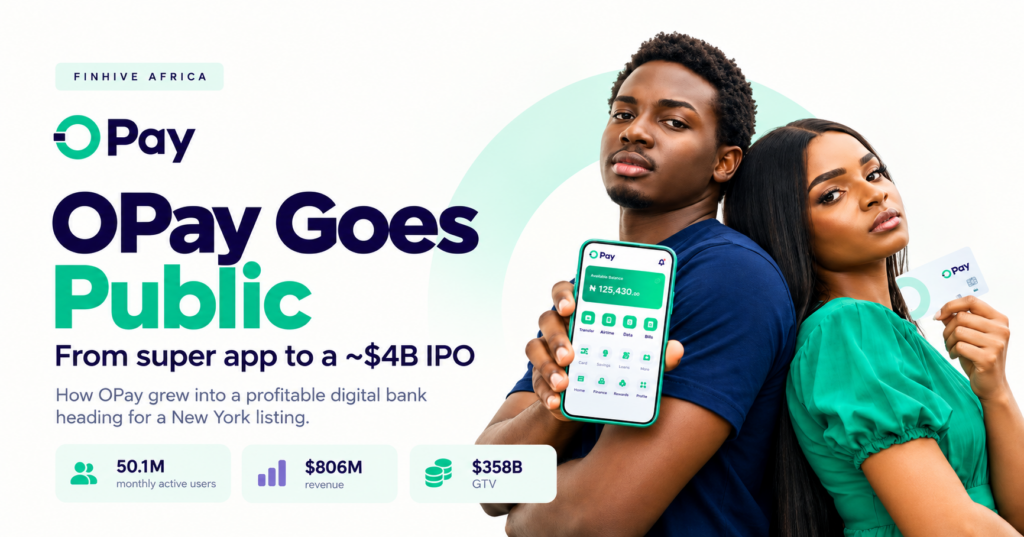
OPay filed for a New York listing on October 9, 2026. Here is how a Nigerian payments app became a profitable digital bank, who owns it, where it earns, and what its IPO means for you.
On October 9, 2026, OPay filed to list its shares on the New York Stock Exchange under the ticker OPAY.
The filing ends years of guessing about OPay’s numbers. It shows a company that more than doubled revenue in six months and earned $90.9 million in net income over the same period.
OPay would be the first fintech with a mostly Nigerian customer base to list in the United States. Two days after the filing, reports confirmed it also plans a second listing at home on the Nigerian Exchange.
This post walks you through the full story. You will see where OPay started, what it sells, where it earns, who funds it, and what to watch as it heads to market.
OPay at a glance
From super app to digital bank
Norwegian browser company Opera incubated OPay. The company launched an agent-led mobile payments service in Nigeria in August 2018, aimed at a market with a large unbanked population.
Its founder, Zhou Yahui, had already built Beijing Kunlun Tech, the Chinese gaming firm that once owned the dating app Grindr.
2019: Build everything
OPay set out to become a super app. It launched ORide for motorcycle taxis in May 2019 and OFood for food delivery in August. Car-hailing, buses, tricycles, lending, and e-commerce followed, all inside one app.
Investors backed the plan. OPay raised $50 million in July 2019 and $120 million in November.
ORide grew fast. It claimed 10 million rides within its first year. Opera’s filings tied about $36 million of spending to launching and scaling the service.
2020: The reset
On February 1, 2020, Lagos banned motorcycle taxis from its main commercial areas. ORide lost its core market. The pandemic lockdown followed.
In July 2020, OPay paused ORide, OCar, OFood, and its OExpress logistics unit. It kept the business that was still growing. Its mobile money agent service grew 44% between January and April 2020.
2021: The unicorn round
OPay entered Egypt in early 2021, placing POS terminals with merchants to collect bills and payments.
In August 2021, it raised $400 million at a $2 billion valuation. SoftBank Vision Fund 2 led the round. OPay said it would put the money into Nigeria, Egypt, and the Middle East. It was the fund’s first investment in Africa.
2024: The regulator steps in
In April 2024, the Central Bank of Nigeria (CBN) told OPay, PalmPay, Kuda, and Moniepoint to stop onboarding new customers. The order followed claims that accounts on these platforms were used for illicit foreign exchange trades. The fintechs pushed back, saying about 90% of the implicated accounts sat with commercial banks.
The CBN lifted the pause in June 2024 after the fintechs tightened customer checks. OPay began physical address verification for merchants on OPay Business. The same year, the CBN gave OPay its Financial Inclusion Innovation Award.
2026: The listing year
The CBN upgraded OPay’s licence to national status in January 2026. OPay filed confidentially for a US IPO on February 12 and publicly on October 9.
What OPay sells
OPay describes itself as a mobile-first platform that combines payments, savings, credit, and lifestyle services. In Nigeria, it operates under Mobile Money Operator and Microfinance Bank licences.
Wallet and transfers
Send and receive money from your phone. This daily habit supports every other product.
Bill payments
Pay recurring bills inside the same app you use to send money.
Savings
Keep money in the app between payments, so balances stay on the platform.
Credit
Consumer loans. Quarterly unique borrowers in Nigeria rose 119% to 4.6 million.
POS and agent banking
Cash and card payments through a network of agents and merchants across Nigeria.
Merchant acquiring
Payment acceptance for businesses. This is OPay’s main product in Egypt and Pakistan.
Users stack products. That stacking explains much of OPay’s growth.
of Nigerian wallet users engaged with more than five products by March 2026
of that multi-product group stayed active the following month
daily to monthly active user ratio in the fourth quarter of 2025
Where OPay makes money
OPay runs in four countries. Each market gets a different product. Nigeria earns almost all of it.
Nigeria’s weight is growing. It made up 89.5% of revenue in the first half of 2026.
How big is OPay in Nigeria?
- The filing calls OPay Nigeria’s No. 1 digital banking platform and the country’s No. 2 app across all categories by daily active users, as of July 31, 2026.
- It ranks as the No. 1 finance app in Africa and the Middle East, with a 9.9% share of monthly active users in the six months to June 2026, based on Frost & Sullivan data.
- A KPMG and Orange study of 13,251 people in 12 Nigerian cities found the OPay app on 69% of surveyed smartphones, ahead of every other finance app.
- OPay passed 45 million users and over one million merchants and businesses in Nigeria by mid-2026.
OPay does not compete alone. OPay, Moniepoint, and PalmPay together serve over 90 million users and hold most of Nigeria’s mobile money segment.
The numbers behind the IPO
OPay’s audited accounts show a company that crossed into profit in 2025 and kept accelerating in 2026.
The profit is not a one-line accounting result. In 2025, operating income moved from a $35.1 million loss to a $107.1 million profit. EBITDA reached $113.2 million, a margin of about 21.1%. Operating cash flow came close to $152 million.
Who owns OPay
OPay raised about $570 million across three private rounds. Chinese venture firms and SoftBank provided most of the capital.
| Round | Date | Amount | Backers |
|---|---|---|---|
| Series A | Jul 2019 | $50M | Opera, Meituan, IDG Capital, Source Code Capital, Sequoia Capital China, GSR Ventures |
| Series B | Nov 2019 | $120M | Meituan, SoftBank Ventures Asia, Bertelsmann Asia Investments, Gaorong Capital, Sequoia, GSR Ventures, Source Code Capital, Redpoint, IDG Capital |
| Series C | Aug 2021 | $400M | SoftBank Vision Fund 2 (lead), SoftBank Ventures Asia, Sequoia Capital China, Source Code Capital, Meituan’s DragonBall Capital and Long-Z, Redpoint China, 3W Capital |
| IPO placement | Pending | Up to $200M | Stanbic Africa Holdings (Standard Bank Group) |
The stakes we know
The incubator valued its stake at $294.6M at the end of 2025.
Combined holding before the offering, per the filing.
Maximum stake after the IPO through Stanbic Africa Holdings.
The Standard Bank deal
Africa’s largest bank by assets is buying into Nigeria’s largest finance app.
OPay and Stanbic Africa Holdings signed a memorandum of understanding on August 14, 2026. Four days later, Bloomberg reported the two were in talks. OPay declined to comment, and Standard Bank said it does not comment on market speculation. The October 9 filing made it official. Standard Bank Group will invest up to $200 million in a private placement that runs alongside the IPO.
Flat cap on the investment
of Standard Bank Group’s qualifying regulatory capital
The cost of a 4.99% stake in OPay at the IPO price
The final size depends on currency moves. With some exceptions, Standard Bank cannot sell the shares for 12 months after the prospectus date.
Three roles in one deal
Investor
Buys up to 4.99% of OPay at the IPO price.
Board member
Lungisa Fuzile, CEO of Standard Bank’s Africa Regions, joins as a non-executive director.
Bookrunner
Works on the listing next to Citigroup and Deutsche Bank.
What they plan to build
The non-binding MoU names three areas of work.
- Merchant acquiring. Payment acceptance for businesses.
- Wealth products. Distribution of savings and investment products.
- Foreign exchange. FX services as a joint line of business.
The MoU does not commit either side to a specific project. Each one still needs definitive agreements and regulatory approval.
What each side gets
- Standard Bank gains a route into payment volumes that have moved from branches to apps, transfers, and agents, without building that network itself. It already operates in Nigeria through Stanbic IBTC Holdings.
- OPay gains a major African bank as a strategic shareholder as it pitches global investors.
Standard Bank CEO Sim Tshabalala framed the fit as banking expertise and an African footprint meeting OPay’s digital platform and merchant base.
Valuation and the IPO
OPay’s IPO target is double the price of its last private round.
The deal at a glance
| Exchange and ticker | NYSE, OPAY, as American depositary shares |
| Estimated raise | Up to about $500M, per Renaissance Capital |
| Joint bookrunners | Citi, Deutsche Bank, Standard Bank, CICC |
| Pricing terms | Not yet disclosed |
| Concurrent placement | Up to $200M from Stanbic Africa Holdings |
| Home listing | Secondary listing on the Nigerian Exchange after the NYSE debut |
The Lagos question
Nigerian investors have asked why a company that earns most of its money in Nigeria chose New York first. NGX Group CEO Temi Popoola has pressed firms like OPay to let local investors share in the value built from Nigerian customers.
OPay answered with a dual listing. It also warned that its NGX shares may not trade interchangeably with its NYSE shares at first. That could split liquidity and raise volatility.
Is $4 billion fair?
Bulls point to growth. Revenue more than doubled in the first half of 2026.
Sceptics point to Nigeria’s banks. Zenith and GTCO both trade below OPay’s $4 billion target, yet each earns around 10 times OPay’s profit. The market will decide whether a digital lender deserves a higher multiple than a traditional bank.
Timing adds pressure. OPay filed as rising bond yields and high interest rates cooled demand for new listings, pushing several companies to delay.
What to watch
One-country exposure
Nigeria produced 89.5% of first-half 2026 revenue. Any naira shock or policy change hits most of the business at once.
Credit quality
Borrowers more than doubled in a year. Fast loan growth can hide bad loans until conditions worsen.
Regulation
Since April 1, 2026, the CBN limits POS agents to one financial institution. Analysts say large platforms like OPay stand to gain. The 2024 onboarding pause shows how fast rules can shift.
Competition
Moniepoint and PalmPay fight OPay for the same merchants and users. Banks are also buying into the space, as Standard Bank shows.
IPO window
High rates have cooled the US listing market. A delay or a lower price would reset the valuation story.
Liquidity split
Two listings that do not trade interchangeably at first could mean thinner trading in each market.
What this means for you
Study the Standard Bank model. Equity, a board seat, and joint products in merchant acquiring, wealth, and FX give you reach into a fintech’s user base without building a rival app.
Profit came before the listing. OPay filed after it turned profitable. Track how many products each user holds. OPay’s 70% multi-product rate shows what depth looks like.
Expect platforms at this scale to buy more credit scoring, KYC, fraud, and merchant acquiring technology as lending grows and rules tighten.
The NGX debate raises a policy choice. Decide how local investors can share in value that local customers create, without blocking access to deeper foreign capital.
Read the F-1 risk factors on Nigeria concentration and loan performance. Compare OPay’s multiple with listed Nigerian banks before you decide.
The bottom line
OPay dropped its ride and food apps in 2020 and rebuilt around payments. Six years later, that focus has produced a profitable digital bank with 50 million monthly users, a major African bank as a shareholder, and a path to the NYSE.
Data notes
- FY2025 revenue. One report cites $614.8M, up 28%. This post uses the audited $536.3M from OPay’s IPO documents. The H1 figures and the $806M trailing revenue both match the audited number.
- Net income. Net loss attributable to ordinary shareholders differs from operating profit because of non-cash accretion on preferred shares, which convert at a qualified IPO. Some trackers therefore show a small trailing loss.
- Bookrunners. May 2026 reports named JPMorgan. The October filing summary lists Citi, Deutsche Bank, Standard Bank, and CICC.
- Stanbic amount. $200M is a cap. The $185M estimate comes from one South African outlet and depends on exchange rates.
- Valuation. The $2.7B and $3.1B figures are implied from Opera’s carrying value, not priced rounds. Opera notes its IPO probability input is not a market forecast.
- Founder name. Some outlets call the founder James Zhou. He is the same person as Zhou Yahui.
- Founding year. Renaissance Capital lists 2017 as the founding year. Most sources date the Nigerian launch to August 2018.
FinHive Africa is an independent intelligence platform. This post is for information only and is not investment advice. Figures are correct as of 13 October 2026 and may change as the IPO proceeds.