
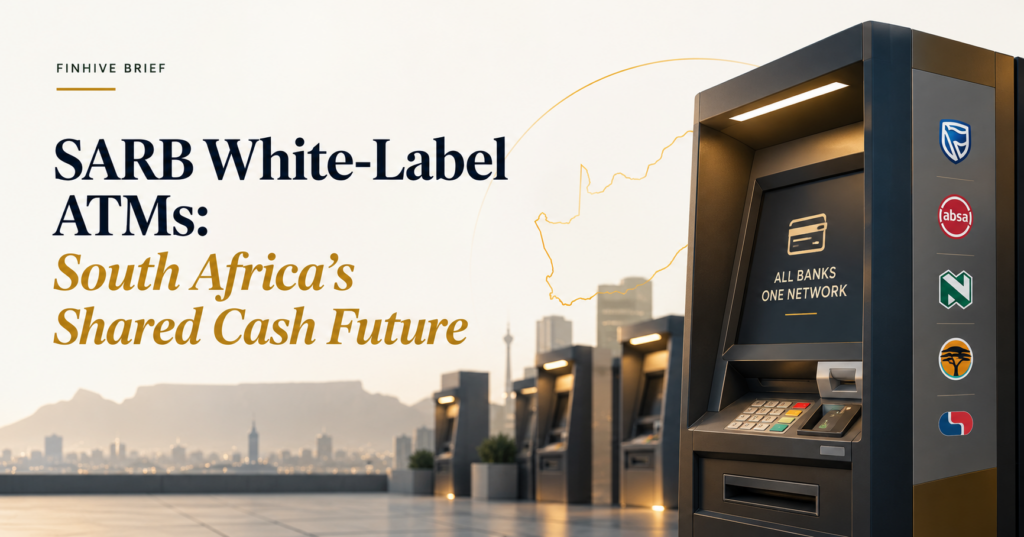
SARB’s White-Label ATM Plan: From Bank Networks to National Infrastructure
South Africa’s proposed shared ATM network could make cash easier to access and change what gives a bank its competitive edge. The outcome will depend on how the system is funded, governed and run.
For someone withdrawing cash, the most useful ATM is the one nearby that works, has money and charges a fair fee. The name above the screen comes second.
South Africa’s banking system has spent decades building separate networks around those names. The South African Reserve Bank’s white-label ATM proposal challenges that arrangement. Under its Cash Smart Strategy, the SARB wants cash access organised increasingly as shared national infrastructure.
The implications reach well beyond the machines. If banks share the infrastructure that puts cash into customers’ hands, they will have to work harder to distinguish the accounts, services and relationships behind it.
What is the SARB’s white-label ATM plan?
A white-label ATM serves customers across banks through a neutral network. Under the proposed model, the machines would be installed and owned by a National Cash Utility, with cash access supported by ATMs, branches and retail withdrawal services.
Many customers can already withdraw from another bank’s ATM. The proposed change goes deeper: shared infrastructure, more consistent access and a different approach to the costs of using the network.
At the SARB’s 16 October briefing, officials outlined an ambition for ATMs to support withdrawals, deposits and balance enquiries, with transactions below a prescribed amount free. The proposal has not yet specified that threshold. Available services will depend on machine capabilities and supporting systems as the model develops.
Behind the ATM sits the proposed National Cash Utility. Its intended role includes consolidating cash centres and coordinating parts of the infrastructure used to process and distribute banknotes and coins. The proposed SARB-owned utility could affect banks and cash companies extensively, although the final asset-transfer, funding and participation arrangements remain under discussion.
Why South Africa is rethinking cash infrastructure
Cash still accounts for approximately 56% of consumer transactions by volume, based on research using 2024 as its base year. Digital payments are growing alongside a substantial, continuing need for physical money.
The expense extends well beyond withdrawal fees. The annual cost of cash is estimated at roughly R90 billion. That estimate includes direct and indirect costs, such as fees, travel, queuing, security and losses. It is a measure of the wider economic burden, rather than an ATM operating bill.
Duplicated infrastructure and cash routes add to that burden. Separate providers can incur overlapping costs serving the same locations, while commercially less attractive communities struggle for convenient access.
Pooling infrastructure offers a way to address both problems. A shared system could plan coverage around where people need cash and coordinate the facilities and movements required to supply it. Those efficiencies would matter most if they reached households through lower charges, shorter journeys and more reliable service.
One shared foundation
for cash access
by volume use cash
research baseline
cost of cash
and banking services
processing and distribution infrastructure
Branches and retailers
Cash use and ATM count reflect a 2024 research baseline. Economic cost includes fees, time, travel and other costs. Schematic illustrates infrastructure roles.
South Africa’s biggest ATM networks have different stakes
The proposal would bring together operators with different footprints, investment histories and reasons for owning machines.
The largest bank networks in a September 2026 comparison were:
| Bank network | Reported ATM footprint |
|---|---|
| Capitec | 8,771 |
| Absa | 5,016 |
| FirstRand / FNB | 4,782 |
| Nedbank | 4,014 |
| Standard Bank | 3,470 |
Figures reflect the banks’ respective reporting periods and device definitions, including cash recyclers or other self-service devices in some networks. They are indicative footprints, rather than a like-for-like count on one date.
Capitec’s scale helps explain the strategic tension. A broad physical network can give customers a practical reason to choose a bank. Sharing access could reduce that advantage, while also lowering the cost of maintaining it. For a bank with a smaller footprint, a shared network could expand effective reach without a matching investment in machines.
The commercial outcome cannot be read from ATM counts alone. It will depend on network charges, compensation for transferred assets and who remains responsible for operating costs.
Independent operators also deserve a place in the discussion. Paycorp’s ATM Solutions, through Cash Express, and Spark ATM Systems are established participants in South Africa’s retail ATM market. They have built access through merchant locations and retail deployments.
Their deployment expertise and retailer relationships could be useful to a shared network. Whether they participate as operating partners, contractors or competing providers will depend on the final rules. Consolidation alone does not establish that their role disappears.
Free withdrawals will matter only if access works
A free withdrawal has limited value if the nearest functioning machine requires an expensive journey.
The customer test should therefore cover the whole experience: distance to an access point, cash availability, queues, opening hours and the time needed to resolve a failed transaction. An urban consolidation that removes overlapping machines may be sensible. Applying the same logic to a community with few alternatives could make access worse.
Retailers can help extend coverage. In cash-recycling models, takings deposited by a merchant become available for customers to withdraw locally. Existing cash-recycling deployments demonstrate this approach. It gives planners another way to support cash access alongside conventional replenishment routes.
The free-transaction threshold will be consequential, but so will the rules around it. Customers need to know which transactions qualify, what other fees apply and where to get help. Those details will determine the value of the promise in everyday use.
Where banks could compete when cash access is shared
For banks, the strategic question becomes how to earn the customer’s business when a nearby ATM offers less reason to favour one institution.
Everyday account quality would carry more weight. Clear pricing, a reliable app, straightforward onboarding and responsive support all influence whether customers keep using an account after withdrawing their money.
Small businesses offer another area for differentiation. A retailer needs deposits reconciled, takings credited promptly, useful records and working capital that fits the business. Shared cash infrastructure could leave banks competing more intensely over those services.
Digital payments would remain part of that competition. Banks and fintechs could win usage by making transfers and merchant payments easier, while continuing to support customers who need cash. A payment option earns adoption when it solves a practical problem at an acceptable price.
For newer providers, neutral access could reduce one disadvantage of having little physical infrastructure. It would still leave the demanding work of building trusted products and resolving customer problems.
A shared network needs clear accountability
Consolidation can reduce duplication while making more participants dependent on common facilities and systems. The operating model must account for both effects.
If an account is debited but the machine dispenses no cash, the customer needs a clear route to a refund. Behind that simple expectation sit responsibilities for the bank, ATM operator, processor and utility. Those responsibilities should be settled before customers encounter a problem.
The same applies to outages, fraud, maintenance and cash shortages. A national network needs tested contingency arrangements and service standards that can be measured by location. National averages can conceal persistent failures in the communities the reform is intended to help.
Funding deserves equal attention. Free basic transactions still incur costs. The way those costs are recovered will influence banks’ participation, independent operators’ viability and the charges customers ultimately face elsewhere.
When could white-label ATMs launch?
The timetable remains a set of implementation targets. The October briefing set out January 2027 for a pilot and March 2027 for establishing the utility. The deployment timetable envisages planning during 2027 and rollout starting in 2028.
These milestones should not be read as a guarantee that every ATM will change by 2028. The SARB describes a phased transition shaped by consultation, readiness and continuity of service.
The most persuasive evidence will come from operating results: whether people travel less, pay less and find cash available when they need it.
South Africa has an opportunity to make cash access a dependable foundation beneath a more competitive banking market. Banks could then devote more of their investment to services that customers actively choose. The reform will have earned its place when someone can use a nearby machine, receive their money and get on with the day, without the bank name above the screen deciding the cost or convenience.