 Banking and Payments Intelligence
Deals and M&A
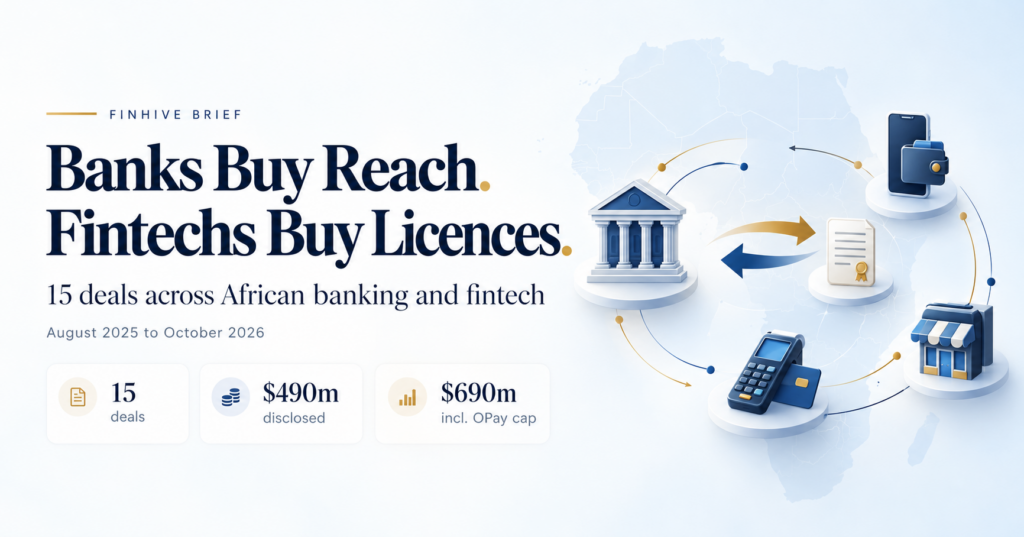
Banks buy reach. Fintechs buy licences.
Fifteen deals since August 2025 show both sides moving toward the same model. Here is who bought whom, why, and what it changes for you and your customers.
Banks buying into fintechs
Fintechs buying banks
For a decade, African banks and fintechs competed for the same customer. Over the past 15 months, they started buying each other instead. The two sides want different things, and both are paying for what they cannot build fast enough.
Banks want the merchants, small business relationships and credit data that wallets took from them. Fintechs want what only a bank licence gives them: permission to take cheap deposits and lend against them. Kenya has stopped issuing new licences and Egypt has frozen new consumer finance licences, so buying one is now the fastest route.
- $490m
- Disclosed value banks have completed or committed to fintech deals since August 2025.
- $690m
- The bank-side total if Standard Bank’s OPay stake, tied to OPay’s New York IPO, closes at its $200m cap.
- 0
- Completed fintech-buys-bank deals that published a price.
- 84
- African tech M&A deals counted by TechCabal Insights by 17 August 2026, against 68 in all of 2025. Financial services led with 27.
Banks are buying merchants, data and credit engines
South African lenders put in most of the money. Egypt’s two largest banks took equity in a fintech for the first time. Three of the bank deals are minority stakes timed with a stock listing, which lets a bank buy at a market-tested price.
| Buyer | Target | Announced | Stake | Value | Status |
|---|---|---|---|---|---|
| Completed | |||||
| Nedbank | iKhokha, South Africa. SME card acceptance | Aug 2025 | 100% | R1.65bn cash (~$93m) | Completed 1 Dec 2025 |
| FirstRand | Optasia, AI credit platform. Dubai HQ, JSE listed | Oct 2025 and Mar 2026 | 20.1%, then 26.1% | ~R4.7bn + R1.48bn | Completed |
| National Bank of Egypt (Al Ahly Capital) | MNT-Halan, Egypt | Jun 2026 | Undisclosed | Led round at $1.4bn valuation | First close done |
| CIB Egypt | MNT-Halan IPO, cornerstone investor | Sep 2026 | Undisclosed | Up to EGP 2bn (~$37m) | IPO listed 20 Oct 2026 |
| Pending | |||||
| Standard Bank (Stanbic Africa Holdings) | OPay, Nigeria. NYSE IPO | Oct 2026 | Up to 4.99% | Up to $200m | Awaits IPO pricing |
| Capitec | Walletdoc, South Africa. Payment gateway | Dec 2025 | 100% | Up to R400m (~$23.5m) | Conditional approval recommended |
| KCB Group | Pesapal, Kenya. Five markets | Nov 2025 | 22.23% | Undisclosed | Regulatory review |
Standard Bank pays the lowest of $200m, 0.98% of its qualifying regulatory capital, or 4.99% of OPay at the IPO price. At the $20 midpoint of OPay’s range, that is about $183.6m.
The bank deals that matter most
- FirstRand is the largest bank investor. It paid about R4.7bn for 20.1% of Optasia at its November 2025 JSE listing, then R1.48bn more in March 2026 to reach 26.1%. Optasia’s share price fell about 43% between February and June 2026 after Nigeria suspended airtime credit services. Your stake in a fintech carries its regulatory risk too.
- Standard Bank is writing the biggest single cheque. It also takes an OPay board seat and acts as an underwriter on the IPO. OPay had 50.1 million monthly active users and $339.1bn in transaction value in the first half of 2026.
- Nedbank made the cleanest full takeover. iKhokha keeps its brand and leadership inside Nedbank.
- Egypt crossed a line. MNT-Halan’s founder said National Bank of Egypt’s investment was the first time a commercial bank became an equity partner in the company.
Fintechs are buying licences, and few publish a price
The fintech deals are smaller, private and built around one asset: a deposit-taking licence. Nigeria and Kenya account for every completed deal.
| Acquirer | Target | Country | Date | Value | Status |
|---|---|---|---|---|---|
| Completed or operating | |||||
| Rank (formerly Moni) | Zazzau MFB, renamed Rank MFB | Nigeria | Nov 2025 | Undisclosed | Announced as acquired |
| Paystack | Ladder MFB, renamed Paystack MFB | Nigeria | Jan 2026 | Undisclosed | Operating |
| Moniepoint | Sumac Microfinance Bank, 78% | Kenya | Mar 2026 | Undisclosed | Completed |
| Sycamore | Unnamed Kano microfinance bank | Nigeria | May 2026 | Undisclosed | Licence revoked 1 Jul 2026 |
| Pending | |||||
| Lesaka Technologies | Bank Zero, 100% | South Africa | Signed Jun 2025 | R1.09bn, mostly in shares | Awaits Prudential Authority |
| MTN Group | 60% of MoMo PSB and YDFS | Nigeria | Apr 2026 | N152.06bn investment | Target 31 Dec 2026 |
| e-Finance | Tamweely Microfinance, a non-bank lender | Egypt | Aug 2026 | EGP 4.75bn to 5bn | Regulatory review |
MTN’s deal moves the payment service bank within the MTN group. KPMG valued the 60% at N95.5bn. Lesaka’s deal was signed before the coverage window, but its approvals fall inside it.
What the fintech deals tell you
- Paystack wanted to lend. Its switching licence could not take deposits. It plans to start with business loans, citing a ₦13trn SME financing gap, and moved the customers of Brass, the business banking app, into Paystack MFB by July 2026.
- Moniepoint bought its way into Kenya. The Central Bank of Kenya is not issuing new licences. Buying 78% of a 20-year-old tier 3 lender got Moniepoint a deposit licence on day one.
- Sycamore shows the risk. About six weeks after its reported purchase, the Central Bank of Nigeria revoked the bank’s licence in a sweep of 46 microfinance banks. Sycamore blamed compliance failures that came before its purchase. Check the licence before you buy it.
- Regulators also hand out licences directly. In January 2026 the Central Bank of Nigeria upgraded Moniepoint, OPay, Kuda, PalmPay, Paga and others to national microfinance status, with a ₦5bn capital floor. Wave incorporated Wave Bank Africa in Abidjan with FCFA 20bn of capital. Flutterwave holds a national microfinance licence, and its CEO says it is buying an unnamed East African bank.
A small microfinance licence with no published price can change a fintech’s funding cost more than a $200m stake changes a bank.
Why banks buy fintechs
- To win back the merchant. Four of the six fintechs banks bought into run payments or merchant acquiring: OPay, iKhokha, Walletdoc and Pesapal. Owning the till gives a bank fee income plus the transaction data to price working capital loans.
- To compete with wallets. M-Pesa processed about 46.4 billion transactions worth KES 41.7trn in its 2025/26 financial year. Banks cannot match that reach by building alone.
- To move faster. Building a licensed payments business can take up to 18 months. Capitec bought Walletdoc’s gateway, wallets and instant EFT tools ready to run.
- To buy credit decisioning. FirstRand says it wants Optasia’s AI to improve credit for underbanked customers.
- To own a share of profitable fintechs. OPay’s net income rose to $90.9m in the first half of 2026, up from $21.7m. Airtel Money listed in London at about £5.3bn.
- To limit their own risk. KCB’s strategy team says minority stakes let the bank tap fintech growth without carrying the full operational and regulatory load.
Why fintechs buy banks
- For cheaper funding. Debt rose from 18.5% to 36.7% of disclosed African startup capital between the first halves of 2025 and 2026. Deposits cost less than borrowed money. Lesaka says Bank Zero lets it fund loans from deposits instead of bank debt.
- For licences regulators will not issue. Kenya has frozen new licences. Egypt froze new consumer finance licences, which pushed e-Finance toward Tamweely.
- To meet rising capital floors. Nigeria’s bank recapitalisation deadline passed on 31 March 2026. Kenya’s draft payments bill would raise the minimum capital for e-money issuers from KES 20m to KES 250m.
- To control settlement and lending. A bank licence lets a fintech hold customer money, settle it and lend it, without a sponsor bank taking a cut.
What changes in the business model
Moving money is becoming free. The money now sits in balances, credit and software.
- Transfer fees are disappearing. SBM Bank Kenya made PesaLink transfers free from May 2026. Its deposits grew 23% to KES 89bn. In 2025/26, 58% of M-Pesa transactions were free, yet M-Pesa revenue still grew 13.4%.
- Card acceptance is getting cheaper. Morocco cut its interchange cap to 0.50% from 1 October 2026 and opened card acquiring to fintechs.
- Bundles replace single products. Moniepoint says it wants the full merchant value chain, beyond transaction fees. That means software, payments and credit sold together.
- Regulators now shape the deal. Capitec must open Capitec Pay to rival payment providers as a condition of the Walletdoc deal. Nigeria bars any group with over 25% of consumer card issuing from holding over 15% of merchant acquiring. South Africa’s Reserve Bank plans to publish rules by end-November 2026 that let non-banks connect to payment systems directly.
- Integration work is still ahead. Most buyers keep the target’s brand and team for now. Nigeria’s data localisation deadline, Kenya’s proposed open finance rules and interoperability orders will force core banking, switching and compliance systems together. No buyer has published what that integration will cost.
What changes for customers
What customers gain
- Cheaper transfers and card acceptance as fees fall.
- More choice at the till. Merchants on rival platforms can still accept Capitec Pay.
- More SME credit. Paystack, Moniepoint and Lesaka all plan deposit-funded lending. No outcome data exists yet.
- Better protection of wallet money. Kenya’s draft bill puts it in protected trust accounts.
What customers risk
- Fewer, larger groups holding more of their data. South Africa’s Information Regulator fined FNB R1m on 27 October 2026 after 696 customers could see 88 others’ home loan applications.
- Dispute handling under strain. An October 2026 audit marked down OPay and PalmPay over unresolved customer disputes.
- Licence risk. Sycamore’s customers saw their bank’s licence revoked within weeks.
- Costs that move from fees to interest when free transfers are funded by lending.
What to watch next
- OPay prices its NYSE IPO. That sets the final size of Standard Bank’s stake, which must also fit Nigeria’s issuing and acquiring cap.
- South Africa’s Reserve Bank publishes its framework for direct non-bank access to payment systems.
- MTN’s MoMo PSB transfer targets completion. Groups affected by Nigeria’s concentration cap face pressure to restructure.
- Nigerian payment transaction data must be stored in Nigeria.
- Long-stop date for Lesaka’s purchase of Bank Zero, South Africa’s zero-fee bank.
The same model, from two directions
Banks pay cash for distribution and data. Fintechs buy licences and mostly keep the price private. Both end up selling payments, deposits and credit to the same merchant.
Regulators decide how far that goes. Capitec’s opened payment rail, Nigeria’s issuing and acquiring cap and South Africa’s non-bank access plan all limit the closed models these deals set out to build.
For your institution, the question is timing. Build, partner or buy, the technology work on core banking, switching and compliance arrives with the 2027 deadlines either way.
Which bank or fintech do you expect to make the next move?
How we built this: FinHive Africa compiled these deals from company announcements, stock exchange filings, competition authority notices and regional business press, checked on 30 October 2026. Values are as disclosed. Dollar figures use exchange rates reported at the time of each deal. Undisclosed values are marked as such and not estimated. Status may change as approvals and IPOs complete.