

2027 outlook
FinHive Africa / People & ideas
The executive watchlist · 2027
The people
moving
Africa’s money.
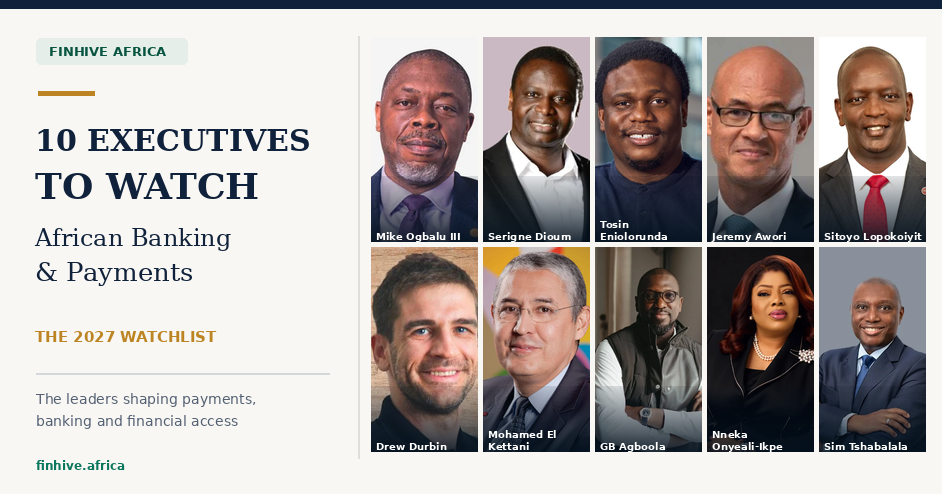
10 executives to watch in African banking and payments in 2027, plus eight more names worth keeping on your radar.

The FinHive perspective
Follow the decisions behind the headlines.
Africa’s financial future is being negotiated in the details: when a merchant receives their money, how a bank uses fresh capital, and whether a payment can cross a border without unnecessary friction.
The people responsible for those decisions deserve attention. Some lead established banking groups. Others run mobile-money platforms, business-finance companies or shared payment infrastructure. Their organisations differ, but the test is practical: can they make financial services work better for the people and businesses that use them?
FinHive’s 2027 watchlist brings ten of those executives together. Each has a defined area of influence and a reason to follow their next phase, from a new mandate or licence to regional expansion or a planned leadership transition.
The watchlist, explained
Where the next chapter takes shape
The main selection
10 executives. Clear reasons to watch.
 PAYMENTS
Pan-African
Mike Ogbalu III
Chief Executive Officer
PAPSS
Connecting African currencies
African businesses should be able to trade with their neighbours without facing a costly detour through distant financial centres. At the Pan-African Payment and Settlement System, Mike Ogbalu III is working on the infrastructure that could make local-currency payments between African markets more practical.
The participation of BEAC, announced in July 2026, gives that ambition a concrete Central African programme. BEAC serves six countries, and PAPSS said work to operationalise the membership would continue through the end of 2026.
His decisions sit close to a fundamental constraint on intra-African trade: how businesses pay one another across currencies and jurisdictions.
More financial institutions going live, usable foreign-exchange liquidity, reliable settlement and repeat business transactions. The measure is money moving successfully, rather than the number of agreements signed.
 PAYMENTS
Multiple African markets
Serigne Dioum
Chief Executive Officer
MTN Group Fintech
Taking mobile money further
Mobile money has brought financial services into everyday life across Africa. The next challenge is to make those services useful in more situations: paying a merchant, buying online or accessing an appropriate financial product. Serigne Dioum oversees MTN’s fintech business at that point of expansion.
In June 2026, MTN announced a partnership with Ant International to introduce a super-app platform and strengthen fraud prevention and connections between financial and commerce services. The announcement provides a specific programme to assess as 2027 approaches.
He combines distribution at scale with responsibility for extending MoMo beyond basic transfers and cash withdrawals.
Evidence that the announced technology reaches customers, more active merchants, dependable transactions and sustained use of additional services.
 PAYMENTS
Nigeria · international expansion
Tosin Eniolorunda
Co-founder & Group CEO
Moniepoint Inc.
Building around the merchant
For a small business, accepting a payment is one part of a working day. Keeping records, paying suppliers and finding finance matter just as much. Moniepoint’s proposition brings those needs together, giving Tosin Eniolorunda a position at the intersection of merchant payments and business banking.
In its January 2026 review of 2025, the company reported more than six million active businesses and described its expansion into UK diaspora services through MonieWorld. These are company-reported figures and developments, dated to that review.
Moniepoint offers a substantial test of whether payment activity can support a deeper, commercially sustainable relationship with small businesses.
Use of services beyond payment acceptance, the performance of business loans and the ability to expand while maintaining reliable service and compliance.
 BANKING
Pan-African · headquartered in Togo
Jeremy Awori
Group Chief Executive Officer
Ecobank Transnational Incorporated
Making a regional network work harder
Ecobank’s network gives Jeremy Awori a platform that few domestic banks can match. The harder task is turning that reach into a consistent experience for a business collecting payments, managing cash or trading across several African countries.
The group’s June 2026 shareholder announcement described a presence in 34 sub-Saharan African countries and continued execution of its Growth, Transformation and Returns strategy. Its combination of banking and transaction services makes Awori relevant to the future of both regional finance and payments.
He is responsible for converting an established pan-African network into better customer service, greater transaction activity and sustainable returns.
Cross-border business activity, growth in transaction banking, digital adoption and operating efficiency across the network.
 BANKING
South Africa · wider African franchise
Sitoyo Lopokoiyit
Chief Executive: Personal and Private Banking
Absa Group
Bringing mobile-finance thinking into banking
Sitoyo Lopokoiyit’s move to Absa is one of the clearest leadership stories behind this watchlist. After leading M-PESA Africa, he became Chief Executive of Personal and Private Banking at Absa, effective 1 April 2026.
His appointment puts experience in mobile financial services inside a large banking franchise. That creates a useful test: whether simpler products, more accessible distribution and closer attention to everyday financial needs can improve established banking relationships.
He has a new mandate, relevant operating experience and a sizeable franchise in which to demonstrate the commercial value of a different approach.
Customer acquisition, digital engagement, service quality and the performance of the personal and private banking division as his agenda takes shape.
 PAYMENTS
Primarily West Africa
Drew Durbin
Co-founder & Chief Executive Officer
Wave Mobile Money
Keeping everyday finance affordable
Wave deserves a place in any serious discussion of Africa’s payments future. Its approach to affordable mobile money makes Drew Durbin an important executive to follow, particularly in West African markets where the cost and accessibility of everyday financial services matter deeply.
Wave identifies Durbin as its co-founder and CEO. In a June 2025 financing announcement, Finnfund reported €117 million in debt financing, more than 20 million monthly active users and operations in eight markets. Those figures belong to that announcement; they are not presented here as October 2026 totals.
Wave adds a substantial independent mobile-money business and an affordability lens to a list that spans banks, fintechs and shared infrastructure.
Merchant and business payments, agent liquidity, expansion costs and whether affordable pricing supports sound operating economics at greater scale.
 BANKING
Morocco · wider Africa
Mohamed El Kettani
Chairman & Chief Executive Officer
Attijariwafa bank
Turning expansion into a stronger bank
Mohamed El Kettani brings a North African banking perspective and a clearly dated expansion story. On 1 October 2026, Attijariwafa bank announced an agreement to acquire 55.22% of Société Générale Ghana, subject to the required approvals.
The proposed transaction would extend the group’s network in anglophone Africa. It also makes 2027 a relevant period in which to assess the progress of the deal and, if it completes, the work of connecting the acquired business with the wider group.
His agenda links regional expansion with the practical challenges of integration, trade finance and serving customers across markets.
Regulatory approval and completion first; then customer retention, integration and commercial connections between Ghana and the group’s other markets. The agreement is not a completed acquisition.
 PAYMENTS
Nigeria · wider African markets
Olugbenga “GB” Agboola
Co-founder & Chief Executive Officer
Flutterwave
Taking more control of financial flows
For an enterprise selling across African markets, the quality of a payment service is often judged after the customer has paid: when the funds arrive, how reconciliation works and whether the service stays reliable. Olugbenga Agboola’s next phase at Flutterwave has a direct bearing on those concerns.
Flutterwave announced a Nigerian microfinance banking licence in April 2026, expanding its ability to hold deposits and manage financial flows directly. The specific licence category matters. It gives the company a concrete opportunity to improve settlement and operating efficiency within its regulated scope.
The licence adds a new operating dimension to an established payments business, creating a clear delivery agenda for the period ahead.
Settlement speed, reliability, customer retention and the commercial benefits of managing more of the financial flow directly.
 BANKING
Nigeria
Nneka Onyeali-Ikpe
Managing Director & Chief Executive Officer
Fidelity Bank Plc
Making fresh capital productive
Nneka Onyeali-Ikpe’s place on this list rests on an operating question facing banks after a capital raise: where should the additional capacity go, and what return will it earn? Fidelity’s October 2026 shareholder update reported eligible capital of ₦532.6 billion following its December 2025 private placement.
The bank’s 2025 annual report sets out priorities including retail growth, SME banking, digital capabilities and transaction banking. These priorities give readers a practical basis for assessing delivery through 2027.
She leads a bank with strengthened capital and an articulated programme for deepening customer relationships and broadening services.
Productive lending, asset quality, fee-generating services and returns on the enlarged capital base.
 BANKING
South Africa · wider Africa
Sim Tshabalala
Group Chief Executive Officer
Standard Bank Group
Delivering through a leadership transition
Some watchlist selections are about a new business. Sim Tshabalala’s is about the execution and continuity of an established institution. Standard Bank’s 2025 integrated report identifies 2027 as his planned retirement year.
At the same time, the group’s March 2026 strategy presentation looks through to 2028. The overlap makes 2027 a consequential period for judging strategic delivery, succession and the transfer of responsibility to the next leadership team.
His planned transition provides one of the most specific 2027 catalysts in the list, with implications across a large regional banking franchise.
Performance against strategic commitments, succession announcements and continuity in investment, customer service and organisational leadership.
Keep these names on the radar
Eight more worth watching
A ten-person list cannot capture every important business or market. These executives add depth across digital ventures, banking technology, regional finance and payments. Their inclusion here reflects the format’s limits, rather than a lesser contribution.
Eric Muriuki
Managing executive responsible for growth strategy and ventures
Absa Group
Appointment reported October 2026
A particularly strong name for the wider radar. October 2026 reporting quoting Absa places Muriuki in a newly created role with a pan-African mandate, reporting to Sitoyo Lopokoiyit. His previous work leading NCBA’s digital business and LOOP makes the next phase worth following closely.
The 2027 test: How his experience in mobile savings, lending and financial platforms translates into Absa’s growth initiatives.
Read about his move to AbsaShola Akinlade
Co-founder & CEO
Paystack
Paystack’s January 2026 announcement reported group-level profitability and introduced The Stack Group, a new parent structure supporting ambitions beyond payments.
Watch: Delivery across merchant services and the broader group while maintaining the quality of the core payments business.
The Stack Group announcementDare Okoudjou
Founder & CEO
Onafriq
Onafriq connects payment providers across African markets. Its June 2026 Yuno partnership gives global merchants another route into that network.
Watch: Active cross-border collections and payouts, merchant adoption and effective foreign-exchange execution.
The Yuno partnershipMitchell Elegbe
Founder & Group Managing Director/CEO
Interswitch
Interswitch’s June 2026 collaboration with Temenos sets out a programme to deliver managed banking technology services to financial institutions.
Watch: Customer deployments across core banking, payments and digital channels, and the commercial results of the partnership.
The Temenos collaborationRuth Zaipuna
Managing Director & CEO
NMB Bank, Tanzania
NMB’s 2026–2030 medium-term plan provides a clear framework for following the bank’s next stage of growth and digital distribution.
Watch: Customer growth, financial inclusion and sustainable banking, alongside disciplined credit quality.
NMB’s Agenda 2030Hisham Ezz Al-Arab
CEO & Executive Board Member
Commercial International Bank, Egypt
CIB’s official profile identifies a 2026–2030 strategy under his leadership. Its annual report also outlines digital-banking and regional-expansion ambitions.
Watch: Implementation, regulatory approvals and the economics of reaching customers through new channels.
CIB’s leadership profilePeter Ndegwa
Chief Executive Officer
Safaricom
Safaricom’s role in M-PESA and its Ethiopian expansion make Ndegwa relevant to the convergence of telecommunications, payments and financial services.
Watch: Active financial-services usage, merchant acceptance and the economics of expansion in Ethiopia.
Vodacom’s executive profilesRoosevelt Ogbonna
Managing Director & CEO
Access Bank Plc
Access Bank’s regional network and trade-finance agenda make service consistency and execution across countries consequential. Transaction status matters: its February 2026 notice said the proposed Bidvest Bank deal had reached its long-stop date without completion.
Watch: Regional execution, cross-border banking activity and the delivery of trade-finance services.
Access Bank’s trade agendaWatch what changes for the customer.
A wider network matters when a business can use it. A banking licence matters when it improves a service. Fresh capital matters when it supports productive activity without weakening the institution that supplies it.
That is the lens through which to follow these executives in 2027: what becomes easier, more reliable or more useful, and whether the business delivering it can sustain the improvement.