
Beyond
Banking Apps
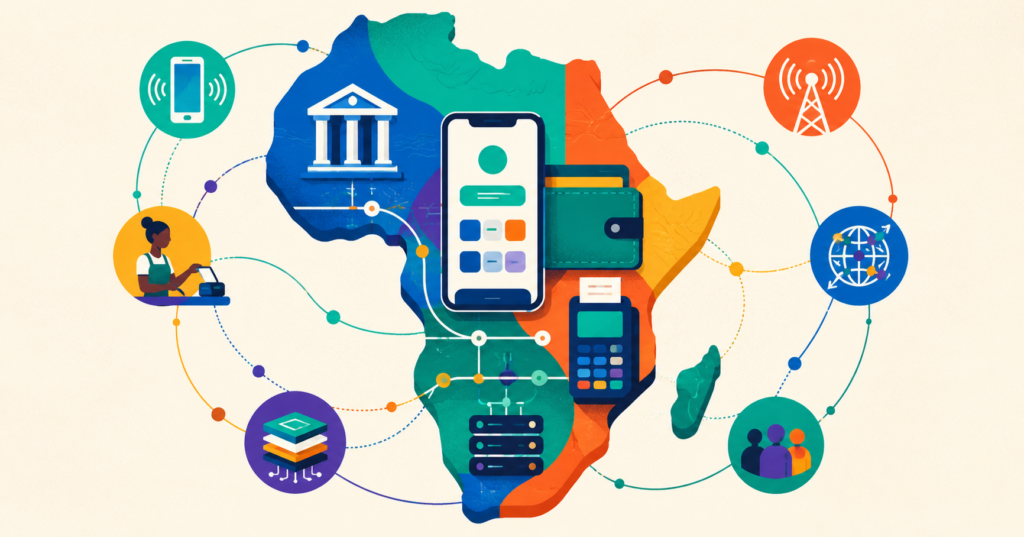
African banks are no longer simply digitising branches. They are building wallets, platforms and payment businesses that redraw the boundaries of banking.
across the continent
African banks are creating digital businesses that extend far beyond ordinary mobile and internet banking.
These propositions can open accounts remotely, hold electronic value, serve people without traditional bank accounts, finance customers, acquire merchants, process payments and support cross-border transfers.
The structures are not identical. Some are brands inside licensed banks. Others are wallets, bank-owned fintech subsidiaries, payment companies or products developed with telecommunications operators.
This FinHive review deliberately excludes routine account-access applications. It covers 35 selected propositions from major African financial institutions, but is not a market-share ranking.
Operating model
Digital-bank propositions
& fintech subsidiaries
Standalone experiences do not always mean standalone licences. These eight propositions show the spectrum from an internal digital brand to a fintech subsidiary.
LOOP
LOOP DFS is NCBA Group’s digital financial-services subsidiary. Its platforms cover payments, credit, savings, investments and merchant services. Regulated banking products are provided through NCBA.
ALAT
A dedicated digital-bank brand operated by Wema Bank, offering remote account opening, savings, payments, cards and credit under the bank’s licence.
OneBank
A fully digital proposition powered by Sterling Bank, providing accounts, payments, investments, credit and related services.
Apollo
A dedicated digital proposition supporting remote account opening, biometric authentication, digital cards, savings and personal loans.
L’bankalik
A mobile-first banking brand for remote onboarding and digital financial services, operating within Attijariwafa Bank.
QNB bebasata
A branchless proposition with its own onboarding journey that remains an integral, regulated part of QNB.
PesaPap Digital
A bank-owned fintech subsidiary focused on software products and financial systems for local and international institutions.
Unayo
A digital platform for personal and business accounts, payments, cash services, merchant registration and bulk disbursements.
Stored value
Bank-owned &
bank-linked wallets
Wallets connect cash, agents and merchants to formal finance—often without requiring a conventional bank account.
Transfers, merchant payments, bills, cash services, savings and credit across Kenyan mobile networks.
↗Payments, instant loans, goal-based savings and selected insurance for Absa and non-Absa customers.
↗Transfers, merchant payments, bills and cash services, with funding through mobile money and financial channels.
↗Payments, transfers and agent banking for CBE customers and eligible users without conventional bank accounts.
↗A Dashen-powered wallet for payments, transfers, airtime, bills and cash-in or cash-out services.
↗A telco-neutral, interoperable wallet and digital financial-services subsidiary supporting payments and collections.
↗Transfers, payments, virtual cards, cash services and corporate collections via USSD or a dedicated app.
↗A no-bank-account wallet for transfers, retail cash withdrawal, PayShap, prepaid services and qualifying advances.
↗A phone-based service for storing, sending, spending and withdrawing money.
↗Electronic value, transfers and cash withdrawal without requiring the recipient to hold a bank account.
↗Merchant payments, wallet and bank transfers, bills and agent cash services through Wafacash.
↗An M-Wallet supporting interoperable transfers, merchant payments, cardless ATM withdrawals, bills and airtime.
↗NBE’s digital wallet for payments, transfers and cash services.
↗Interoperable transfers, ATM and agent cash services, QR purchases, bills, airtime and card funding.
↗Interoperable transfers, bills, QR payments, virtual payment cards and ATM or agent cash services.
↗CDF and US-dollar accounts, domestic transfers, cash, airtime, bills and international-transfer functions.
↗Infrastructure
Payment &
remittance businesses
Banks are moving deeper into gateways, merchant acquiring, processing and cross-border payments through dedicated businesses.
Squad
Payment gateways, links, virtual accounts, USSD, card acceptance and transfers.
Explore ↗02EcobankEcobankPay
QR and USSD merchant payments across participating Ecobank markets.
Explore ↗03EcobankRapidtransfer
Remittances connecting accounts, other banks, wallets, cash outlets and selected European corridors.
Explore ↗04Access BankAccessAfrica
Cross-border payments for personal, business, merchant, trade and government-related flows.
Explore ↗05Wema BankALATPay
An online gateway for cards, transfers, phone payments, NQR and merchant storefronts.
Explore ↗06Equity GroupFinserve Africa & Equitel
A fintech portfolio spanning Equitel, Jenga API and Jenga Payment Gateway.
Explore ↗07Groupe BCPM2T
A licensed payment institution behind Chaabi Cash, Tasshilat, Chaabi Pay and Chaabi Payment.
Explore ↗08Attijariwafa BankAttijari Payment Processing
Issuing, acquiring, processing, e-payments and prepaid products.
Explore ↗Where banks
meet telcos
Some of Africa’s most familiar financial products are partnerships rather than bank-owned subsidiaries.
M-Shwari ↗
Safaricom’s M-PESA distribution combined with savings and credit accounts held by NCBA Bank Kenya.
KCB M-PESA ↗
A KCB savings and lending product distributed to Safaricom M-PESA customers.
Fuliza ↗
An M-PESA overdraft involving Safaricom, NCBA and KCB, with the banks providing regulated lending capacity.
What this means
for African banks
A separate digital proposition can reach users who may not begin with a conventional bank account. Payment subsidiaries can serve businesses that need APIs, collections, acquiring and settlement—not another retail account.
Eight questions that matter
Who legally holds customer funds
Which institution carries credit and fraud risk
Who the proposition serves — bank customers, non-customers or both
How it connects with banks, wallets, switches and instant-payment systems
How agents and merchants are distributed
How data consent, KYC and transaction monitoring work
Whether governance, technology and reporting are genuinely separate
How availability changes across regulatory markets
“Calling every proposition a digital bank hides the differences.”Stronger analysis starts with ownership, licensing, balance-sheet responsibility and the service being provided.