
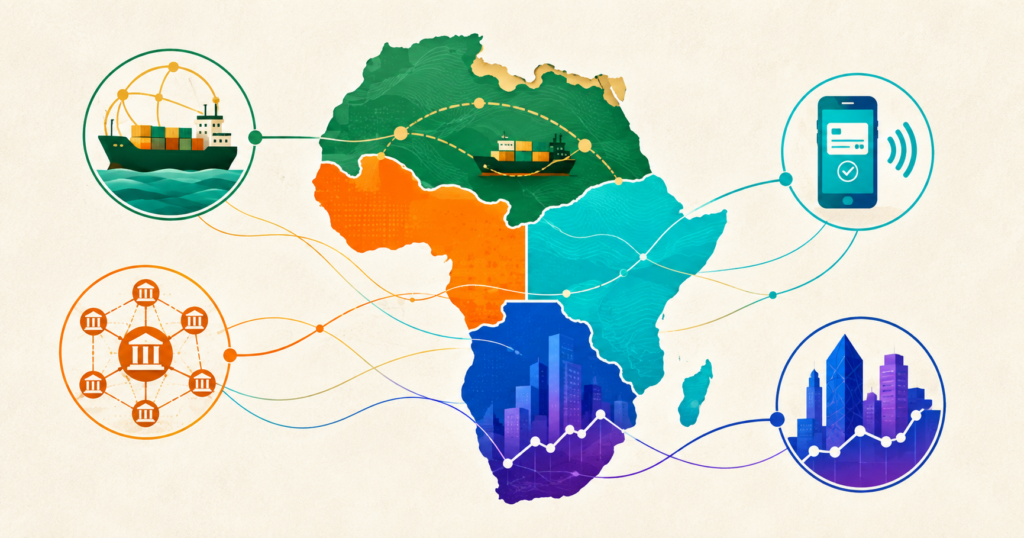
African bankingis regional.
Four regions. Four distinct advantages. The continent’s next great banking model will be built by combining them.
Africa does not have one banking model. That is one of its strengths.
Banks across East, West, Southern and North Africa have developed around different customer needs, economic structures, technologies and regulatory systems. East African banks built around mobile phones and everyday transactions. West African banks created large customer networks and cross-border operations. Southern African banks developed deep corporate, investment and capital-market capabilities. North African banks established strong trade, infrastructure and international banking links.
These differences explain why a model that succeeds in one African market may require substantial changes before it works in another.
Estimated African banking revenue in 2025. South Africa, Nigeria, Egypt, Kenya and Morocco accounted for nearly 70% of the total.
What each region
does best
No ranking. No winner. Just four banking systems optimised for different kinds of value.
The digital retail
banking leader.
East Africa’s main advantage is its ability to serve large numbers of customers through mobile-first financial services.
Banks in Kenya, Tanzania, Uganda and Rwanda operate in markets where mobile money is part of daily economic life. Customers transfer, save, borrow, pay bills and manage businesses through mobile platforms. Banks have learned to connect their systems with mobile-network operators, agents, merchants and fintech platforms.
Products such as M-Shwari, Fuliza, M-Pawa and MoKash show how the region connects bank accounts, mobile wallets, savings and instant credit. Its banks are strongest when they design services around frequent customer activity rather than occasional branch visits.
Extend the digital advantage into SME banking, wealth, insurance and regional trade.
The scale and
expansion leader.
West Africa combines market size, geographic reach and cross-border financial services better than any other region.
Nigeria brings a large population, a substantial corporate sector and one of Africa’s most active fintech industries. Ghana, Senegal, Côte d’Ivoire and neighbouring markets add strong opportunities in mobile money, remittances and regional banking.
Ecobank, Access Bank, UBA and other groups have shown that African banks can operate across currencies, languages and regulatory systems. West Africa recorded Sub-Saharan Africa’s highest number of registered mobile-money accounts in 2024, though East Africa achieved stronger active usage.
Turn registered digital accounts into active, reliable and profitable relationships.
The institutional
banking leader.
Led by South Africa, the region has the continent’s deepest institutional banking capabilities.
Its banks serve large companies, governments, institutional investors, infrastructure developers and high-net-worth individuals. Strong capital and liquidity supported profitability above South Africa’s ten-year average during 2025.
The Johannesburg Stock Exchange remains Africa’s largest by market capitalisation. At the end of 2025 it ranked eighteenth globally, at approximately R24 trillion. That depth supports corporate finance, listed securities, bonds, derivatives, custody and investment management at a scale still limited elsewhere on the continent.
Combine institutional expertise with East Africa’s accessible, mobile-first customer model.
The trade and
connectivity leader.
North African banks operate at the intersection of Africa, Europe and the Middle East.
Egypt and Morocco have large domestic markets. Their banks finance major companies, public projects, trade corridors, property and infrastructure. Moroccan banking groups have also expanded across Francophone Africa; Attijariwafa Bank is present in 27 countries, including 15 African markets.
The region’s geography supports trade with Europe, the Gulf and Asia. Experience across conventional and Islamic finance creates further openings in sukuk, trade finance, asset-backed lending and infrastructure investment.
Accelerate retail digitisation and reduce dependence on cash in domestic markets.
The best model
is a hybrid.
Africa’s strongest future bank borrows intelligently from every region.
African banking platform
That platform could deliver mobile-first retail banking, regional payments, SME credit, corporate finance, investment products and international trade services through one operating and technology core.
Banks increasingly compete on how effectively they scale technology, manage data, control risk and improve customer experience.
A 2025 survey of Africa’s financial sector found that institutions increasingly view interoperability, regional payments and digital operations as priorities for continental integration. Progress now depends on five persistent challenges.
- 01Fragmented cross-border payments
- 02High technology and infrastructure costs
- 03Limited access to SME credit
- 04Cybersecurity and fraud
- 05Inconsistent regional regulation
No region has solved every banking challenge. East Africa must deepen corporate and capital-market services. West Africa must improve active digital usage and service reliability. Southern Africa must make banking more accessible and affordable. North Africa must accelerate retail digitisation and financial inclusion.
FinHive viewAfrica does not need one regional model to defeat the others. It needs banks that can combine digital access, customer scale, institutional capability and global connectivity.