
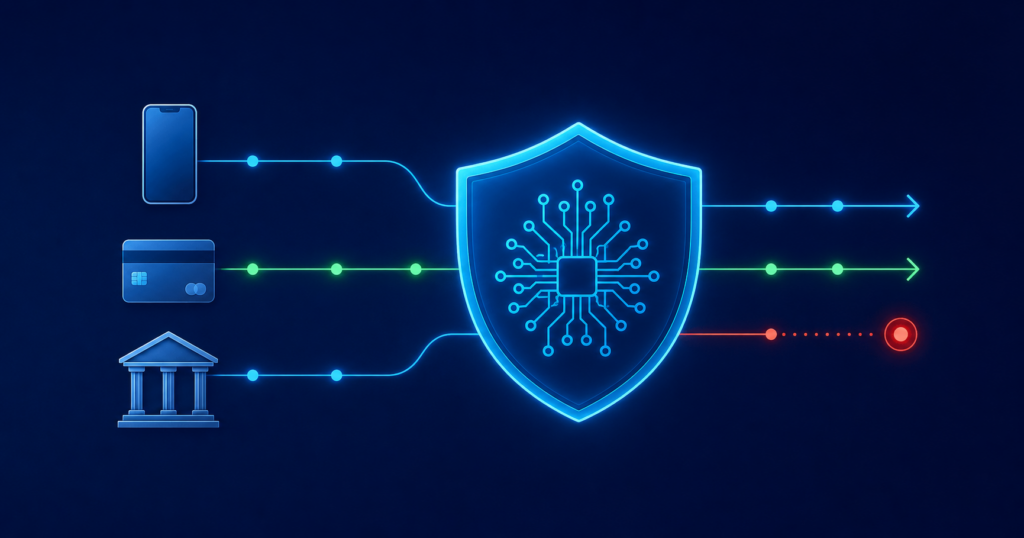
How AI Fraud Detection Works in Financial Institutions
A practical guide to fraud architecture, real-time decisioning, investigation workflows, use cases and implementation planning for banks, fintechs, payment firms and microfinance institutions.
By FinHive Africa July 2026 9 min read
Fraud rarely appears as one suspicious transaction. It appears as a sequence of signals spread across customers, accounts, devices, channels, merchants and beneficiaries.
An AI fraud solution connects those signals. It evaluates each event in context, calculates risk, recommends an action and records the evidence. Investigators then confirm the outcome, allowing the system to improve its rules and models.
What an AI fraud solution must do
A complete solution must support four connected capabilities. Weakness in one area reduces the value of the rest.
Detect
Identify known fraud patterns and new anomalies across real-time and batch activity.
Decide
Convert risk scores and reason codes into clear, risk-based customer actions.
Investigate
Rank alerts, assemble evidence and manage cases with full traceability.
Learn
Feed confirmed fraud and false alarms back into rules, features and models.
AI fraud reference architecture
The architecture starts with live events from banking and payment channels. It adds customer, account, device and historical context. Several detection engines score the event in parallel. A policy layer then decides whether to approve, verify, hold or stop the activity.
Signals and context
Collect channel events and enrich them with customer, account, device, merchant, beneficiary and historical data.
Fraud intelligence
Run rules, machine-learning models, graph analysis and behavioral checks in parallel.
Policy decision
Combine scores, reason codes, channel context and thresholds into one controlled response.
Customer response
Approve low-risk activity, request added verification, hold suspicious activity or stop the transaction.
Case management
Prioritize alerts, preserve evidence, manage investigations, support recovery and record decisions.
Learning and governance
Use confirmed outcomes to tune controls while tracking model versions, drift, approvals and audit history.
The fraud detection workflow
The same workflow can support real-time authorization, near-real-time monitoring and scheduled analysis. Only the decision deadline changes.
Every decision should store the features used, triggered rules, model version, risk score, reason codes and final action. This gives investigators and auditors a clear record of what happened.
Where financial institutions use AI fraud detection
| Use case | Signals and patterns | Possible response | Investigation focus |
|---|---|---|---|
| Account takeover | New device, credential reset, unusual location and rapid beneficiary setup | Request verification, hold the transfer and secure the account | Session trail, device history and beneficiary relationships |
| Payment and card fraud | Velocity, impossible travel, unusual amount, merchant risk and repeated failures | Approve, challenge, decline or block the instrument | Authorization history, merchant behavior and device context |
| Mule networks | Shared devices, circular flows, rapid cash-out and linked beneficiaries | Limit activity, hold funds and open a network case | Graph relationships and the source and destination of funds |
| Application fraud | Identity mismatch, duplicate attributes, manipulated documents and synthetic profiles | Request evidence, route to manual review or reject | Identity proof, duplication and prior application history |
| Merchant abuse | Refund spikes, collusion, unusual ticket size and chargeback concentration | Review settlement, apply a reserve or suspend the merchant | Merchant cohort, terminals, customers and settlement patterns |
| Internal fraud | Privilege misuse, unusual overrides, abnormal access and staff-linked transactions | Stop the action, isolate access and escalate the case | User activity, approvals and segregation of duties |
How to implement an AI fraud solution
Start with one fraud journey that has measurable loss, usable data and a clear operational owner. A narrow first release makes tuning and accountability easier.
Define the problem
Confirm priority fraud journeys, baseline losses, risk appetite, data sources, channel deadlines, operating ownership and target architecture.
Test the controls
Integrate one or two use cases, run in shadow mode, tune thresholds, test fallbacks, train analysts and measure customer impact.
Expand safely
Add channels and models, automate feedback, monitor drift, improve case workflows and review performance against risk appetite.
Implementation considerations
- Data. Check quality, labels, identity resolution, history depth, consent, retention and residency.
- Integration. Define channel coverage, event schemas, response deadlines, fallback behavior and reconciliation.
- Models. Require validation, explainability, bias testing, drift monitoring, versioning and controlled deployment.
- Operations. Set alert ownership, service levels, maker-checker controls, evidence standards and escalation routes.
- Security. Apply least privilege, encryption, audit logging, high availability and recovery testing.
- Economics. Compare avoided loss with delivery cost, analyst capacity and customer friction.
Metrics that show whether the solution works
Fraud prevention should not be measured by blocked transactions alone. A strict system can stop fraud while rejecting good customers. Use a balanced scorecard.
Questions to ask a fraud technology provider
- Which channels and transaction types can the platform score in real time?
- How does it combine rules, machine learning, graph analytics and external data?
- Can analysts understand the reason behind every alert and action?
- How does the platform operate when a model, data source or integration becomes unavailable?
- How are models validated, approved, monitored and rolled back?
- Can the solution meet local deployment, privacy and data-residency requirements?
- How does case management support evidence, approvals, recovery and regulatory reporting?
- Which results will the pilot measure, and what baseline will be used?
AI fraud detection works best as a controlled decision system
The value comes from combining live events, trusted context, several detection methods and clear response policies. Case outcomes then improve the system over time.
For most institutions, the right starting point is one high-loss fraud journey with strong data and clear ownership. Prove the results, protect good customers and expand from there.
AI fraud detection FAQ
What is an AI fraud detection solution?
It is a system that analyzes transactions, customers, accounts, devices and relationships to estimate fraud risk. It uses the risk result to support approval, extra verification, review or blocking.
Does AI replace fraud rules?
No. Rules remain useful for clear policies and known patterns. Machine learning and graph analysis help identify complex behavior that static rules can miss.
Can the solution work in real time?
Yes, if the data, models and integrations meet the channel’s response deadline. The design should include fallback controls for unavailable services or incomplete data.
Why is case management important?
Case management gives investigators one place to review evidence, record decisions, manage approvals and label outcomes. Those outcomes improve future rules and models.
What should an institution implement first?
Choose a fraud journey with measurable loss, accessible data and a clear owner. Account takeover, suspicious transfers or card fraud often provide a focused starting point.