
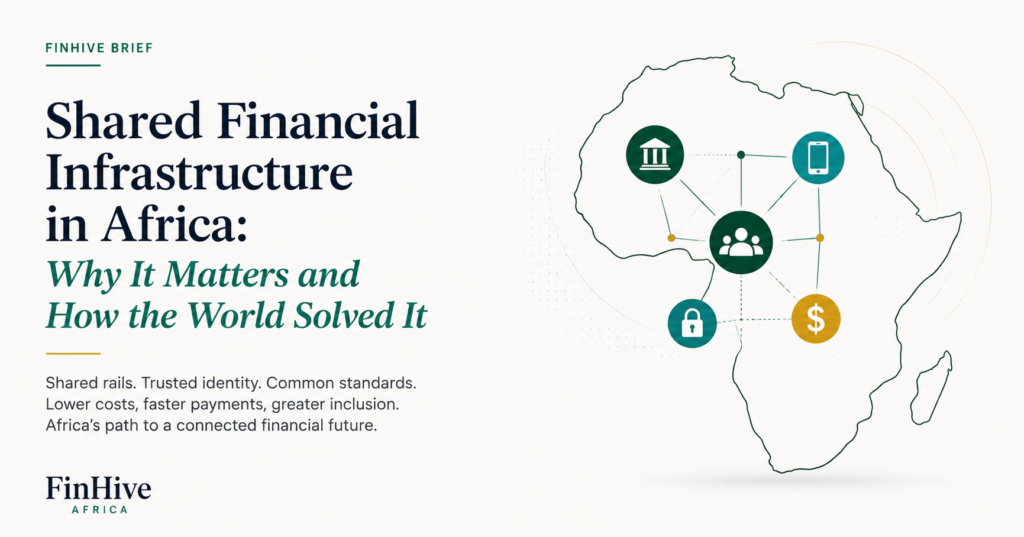
Shared Financial Infrastructure: Africa’s Path to Cheaper, Faster Finance
Africa keeps building the same plumbing in every market. Shared rails, identity, and standards are the fix. Here is why it matters, what blocks it, and how Brazil, India, and Europe already solved it.
Africa’s financial firms keep building the same plumbing in every market. A new licence. A new switch. A new set of data rules. Each border resets the work, and the customer pays for the repetition.
The 54-times problem
Africa is not one market. It is 54 countries, more than 40 currencies, and dozens of separate rulebooks. A fintech that wants to serve the continent often rebuilds its core systems again and again, market by market.
That duplication is the single biggest tax on scale in African finance. It raises the cost of every transaction. It slows every expansion. It keeps prices high and locks millions out of formal finance.
Shared financial infrastructure breaks the cycle. The idea is simple. Build the common layer once. Let everyone use it. Then compete on the product, not the plumbing.
Why shared infrastructure is important
Shared infrastructure is not a technical nicety. It changes the economics of finance for a whole continent. Five gains stand out.
- Lower cost. When firms share rails and identity checks, the fixed cost of building drops for everyone. Cheaper inputs mean cheaper transactions for customers and merchants.
- Wider inclusion. Shared rails reach places a single firm cannot afford to serve alone. They turn a phone into a bank account and a small shop into a payment point.
- Faster competition. A startup that plugs into a public rail can launch in weeks, not years. The barrier shifts from infrastructure to ideas, which favours new entrants.
- Cross-border trade. Common rails let money move between countries in local currency. That supports the African Continental Free Trade Area and the small traders who power it.
- Resilience. One shared, well-run system is easier to secure and monitor than 50 fragile ones. A common security baseline protects the whole market at once.
What Africa already has
Shared infrastructure is no longer theory on the continent. The foundations are being laid right now.
- Common payment rails. PAPSS links about 19 countries and 160 banks, settling in local currencies with no dollar middle step.
- Instant payments at scale. 36 instant payment systems run across 31 countries, moving close to 2 trillion dollars in 2024.
- Fintech passports. Kenya and Rwanda signed a licence passporting deal in 2026. One licence, two markets.
- Open standards. Kenya and Nigeria run national QR code standards so any wallet scans any merchant.
- Reusable identity. Southern Africa built a federated e-KYC framework. Verify once, reuse across banks.
- Open-source rails. Mojaloop powers full national systems in five countries, letting smaller central banks skip the closed-switch era.
The pieces exist. The hard part is making them connect, scale, and earn trust across borders.
The challenges holding Africa back
Most blockers are about coordination, not code. The technology is the easy part.
- Too many currencies. More than 40 currencies, most with limited convertibility. Many payments still route through the US dollar offshore, which adds cost and delay.
- Fragmented rules. Divergent licensing and weak cross-border coordination raise costs and stall integration. In some regions, firms still apply country by country.
- Thin political will. Harmonisation needs commitment at country level. Sovereignty concerns slow every deal to recognise another country’s rules.
- Low trust between regulators. No regulator honours another’s licence without confidence in how that country supervises its firms.
- Power and connectivity gaps. Data centres face electricity and capacity limits, and a large share of African data still sits offshore.
- No clear business case to share. A firm that built its own rail rarely wants rivals to use it. Shared infrastructure needs a push from the public side to overcome private resistance.
How the rest of the world solved it
Africa does not need to invent the answer. Three regions already proved that shared infrastructure works at scale. Each solved a different blocker.
A central bank mandate beats slow adoption
Brazil’s central bank built Pix, a free instant payment system, and required large banks to join. Launched in late 2020, it reached mass adoption in under two years.
The lesson for Africa: when the public sector mandates participation and makes the rail free, the private business-case problem disappears. Adoption follows the rule.
Build identity first, then open the APIs
India laid a digital identity foundation with Aadhaar, then built UPI as an open public rail on top. Banks and fintechs plug into shared APIs run by a public body. The result is the world’s largest real-time payment system.
The lesson for Africa: reusable identity is the base layer. Open, public APIs let thousands of firms innovate on one trusted rail at low cost. This is the model behind SADC e-KYC and PAPSS.
Harmonise rules across many countries
Europe faced Africa’s exact problem of many countries and one ambition. It built the Single Euro Payments Area to standardise transfers across 36 countries and used the PSD2 rule to force banks to open their data through APIs.
The lesson for Africa: common rules and mutual recognition let many sovereign nations share one payment area. This is the direct template for the Kenya and Rwanda fintech passport and the African Continental Free Trade Area.
The common thread
Pix used a public mandate. India built identity first and opened the rails. Europe harmonised rules across borders. None of it was about better technology. All of it was about coordination, public leadership, and trust. Africa already has the technology. It needs the same three ingredients.
The playbook for Africa
The global cases point to a clear order of work. Sequence matters.
The bottom line
The rails, the standards, and the identity frameworks exist. What slows Africa is fragmented rules, scarce political will, and low trust between regulators. Brazil, India, and Europe show the path: lead from the public side, build identity first, mandate the core rail, and harmonise the rules. Fix the coordination and the cost of finance falls across the continent. The firms that win will treat licences, rails, identity, and data centres as shared utilities, then compete on the product layer above them.
One question worth debating: which blocker should Africa fix first, the currencies or the rules?
Recommended reading for leaders
If you are building or buying financial technology in Africa, start here.
01 Africa’s Top 10 Digital Banks in 2026 The banks setting the pace in digital and mobile-first banking. → 02 Top 10 Digital Banking Software Providers in Africa The core and digital banking platforms powering the continent. →Frequently asked questions
What is shared financial infrastructure?
It is the common plumbing of finance, built once and used by many firms. It covers payment rails, digital identity, regulatory sandboxes, open data standards, and data centres. Instead of each bank or fintech building its own version in every country, the market shares one trusted layer and competes on the products built on top.
Why is shared infrastructure important for Africa?
Africa has 54 countries, more than 40 currencies, and fragmented rules. Building alone means paying for the same infrastructure many times, which keeps transaction costs high and blocks scale. Shared infrastructure lowers cost, speeds cross-border payments, widens inclusion, and lets smaller firms compete.
What are the biggest challenges?
Too many currencies with limited convertibility, fragmented regulation, thin political will, low trust between regulators, and gaps in power and connectivity. Most are coordination problems, not technology problems.
How did Brazil, India, and Europe solve it?
Brazil’s central bank mandated Pix and made it free, reaching about 91 percent of adults. India built UPI on the Aadhaar identity layer with open public APIs, processing over 16 billion transactions a month. Europe harmonised rules across 36 countries through SEPA and PSD2. Each shows that public leadership, shared identity, and common standards work.
What is PAPSS?
PAPSS, the Pan-African Payment and Settlement System, is a shared rail that lets banks across Africa settle cross-border payments in local currencies without routing through the US dollar. It connects about 19 countries and 160 commercial banks as of mid-2026.