
FinHive Editorial / African Payments / Long Read
Africa’s $40 Billion Card Market. The Quiet Revolt Against Visa and Mastercard.
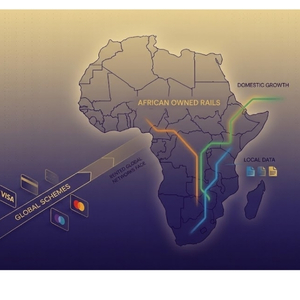
A decade of central bank ambition, fintech volume and pan-African coordination is rewriting who owns the rails of African card payments.
Visa pledged a one billion dollar investment in Africa by 2027. Nigeria’s central bank launched AfriGo to localize card economics. Both moves sit inside the same African card story.
Market estimates put Africa’s card payment market at $40.3 billion in 2025, up from $28.21 billion in 2021, with a forecast of $71.10 billion by 2033. The growth is real, but the base remains small compared with the global card market.
The headline also hides concentration. South Africa and Nigeria carry a large share of African card volume, while the rest of the continent is still unevenly served by cards, mobile money, wallets, QR payments and domestic switches.
The deeper story is infrastructure. For decades, Visa and Mastercard built the international card rails African banks relied on. African issuers gained global acceptance, but local markets also carried foreign currency costs, offshore dependencies and limited control over payment data.
A different model is now in motion. Central banks, fintechs and pan-African institutions are building their own schemes: Verve in Nigeria, Meeza in Egypt, AfriGo in Nigeria, GIM-UEMOA in Francophone West Africa, GIMACPAY in Central Africa and PAPSSCARD across the continent.
The fight is no longer only about who issues the most cards. It is about who owns the rails the cards run on.
01What Africans Actually Carry In Their Wallets
The card mix on the continent breaks into five working categories. Each category tells a different story about where African card payments are going.
Debit dominates
Debit cards remain the workhorse. They are tied to a bank or wallet balance and used at ATMs, POS terminals and online checkout. Across many African markets, debit is the default card product, while credit remains the exception.
Credit stays narrow
Credit cards remain concentrated among higher income urban customers, formal salary earners and users with stronger credit profiles. The constraint is not only demand. It is underwriting, repayment risk, data quality and the high cost of unsecured consumer credit.
Prepaid keeps gaining ground
Prepaid cards are growing because they work for payroll, subsidies, travel, virtual e-commerce, youth banking, gift cards and informal sector payments. For banks and fintechs, prepaid cards can function as a lower-risk bridge into card issuing.
Virtual and tokenized cards are rising
The plastic card is becoming optional. Virtual card numbers now support online checkout, subscription billing and cross-border e-commerce. For African consumers, virtual cards solve a practical problem: safer online spending where merchant fraud controls may reject physical cards from some markets.
Contactless is becoming standard
Contactless is no longer a premium feature. Tap-to-pay is becoming a standard part of new card issuance, transport payments and merchant acceptance. In the next phase, the phone wallet, card token, QR code and bank account will sit much closer together.
02The Networks Fighting For The Continent
The international card scheme map in Africa is still led by Visa and Mastercard, but the competitive field is widening.
Visa, the incumbent
Visa remains one of Africa’s most important international card networks. Its strategy is built on acceptance, trust and global reach. A Visa card that works in Lagos, Nairobi, Johannesburg, London and Dubai gives issuing banks a clear value proposition.
Mastercard, the infrastructure builder
Mastercard has pushed aggressively into African acceptance, real-time payments, tokenization, issuer services and digital identity. Its role is shifting beyond card rails into a broader payment technology layer for banks, fintechs and merchants.
UnionPay, the strategic alternative
UnionPay is expanding across African markets through bank and acceptance partnerships. Its early footprint followed Chinese tourism and trade, but selective issuance and geopolitics could make it more relevant where countries want alternatives to US-linked payment rails.
American Express, Diners Club and JCB
American Express remains a niche premium card in markets such as South Africa, Egypt, Morocco and Nigeria. Diners Club retains legacy relevance in South Africa, while JCB remains tied to tourism and selected online acceptance.
03Country By Country, The Battlegrounds
Africa’s card market is not one market. It is a group of payment ecosystems with different histories, dominant rails and regulatory priorities.
Nigeria, the most contested
Nigeria has the most active card scheme competition on the continent. Mastercard, Visa and Verve already operate at scale, while AfriGo brings a sovereign scheme into the market. Verve’s deep fintech distribution through players such as OPay and Moniepoint shows how local schemes can reach the informal economy faster than traditional bank-led card strategies.
Kenya, where cards coexist with mobile money
Kenya remains a mobile money-led market, but cards still matter for higher value purchases, online checkout and cross-border payments. The useful point is not that cards replace wallets. It is that mature consumers increasingly use several rails depending on the transaction.
South Africa, the mature duopoly
South Africa is the most developed African card market. Major banks issue Visa and Mastercard products, merchant acceptance is broader and card behavior looks closer to mature markets. The country is also becoming a testing ground for real-time settlement and advanced card infrastructure.
Egypt, Meeza country
Egypt is the clearest state-led domestic scheme story. Meeza supports domestic card payments, wallets, government payments and financial inclusion. It shows how a central bank-backed scheme can become part of a wider national payment infrastructure strategy.
04The Domestic Schemes Are The Story
The most important shift in African card payments is not only card issuance. It is the rise of domestic and regional schemes that change issuing economics, payment data control and local settlement options.
Verve, the proof point
Verve is the African domestic scheme story that scaled first. Operated by Interswitch, Verve has grown through bank issuance, fintech issuance and targeted international acceptance partnerships. Its reported annual issuing growth shows that domestic schemes can be commercially relevant, not just regulatory projects.
AfriGo, the central bank play
AfriGo is Nigeria’s sovereign card scheme. Its strategic logic is straightforward: reduce cost exposure, support local settlement, keep domestic transaction data closer to national oversight and strengthen local payment policy control.
Meeza, the scale leader
Meeza shows what state-led scale can look like. It supports domestic card payments, digital wallets, public sector payroll, subsidies, e-commerce and contactless services. Egypt used Meeza to build domestic rails, then connected those rails to a broader digital payment ecosystem.
GIM-UEMOA and GIMACPAY, the regional models
GIM-UEMOA and GIMACPAY show how shared monetary or regional communities can build payment rails beyond a single country. Their role matters because African commerce often crosses borders, but payment systems remain fragmented.
PAPSSCARD, the continental ambition
PAPSSCARD is the newest and most ambitious entry. Its goal is to support intra-African card payments and reduce dependence on external payment networks. If it gains bank participation, merchant acceptance and customer trust, it could become an important rail for African trade and travel.
05The Strategic Logic Behind Domestic Schemes
The reasons for domestic card schemes are consistent across African markets.
- Cut FX leakage: reduce foreign currency exposure on scheme fees and offshore payment costs.
- Reclaim data sovereignty: keep locally generated payment data under stronger domestic or regional oversight.
- Lower transaction costs: reduce costs for issuers, acquirers, merchants and consumers.
- Support financial inclusion: design products for low-income users, informal merchants and public sector payment flows.
- Reduce infrastructure dependency: give central banks and local institutions more control over sensitive payment rails.
Each reason matters on its own. Together, they explain why more African central banks and regional institutions are treating payment schemes as strategic infrastructure.
06Where This Is Going
Several signals will define the next phase of Africa’s card payment market.
Acceptance is the binding constraint
Cards without merchants are only plastic or tokens. Domestic schemes need enough merchant acceptance, online acceptance and cross-border acceptance to become everyday rails.
Mobile money still dominates daily payments
In many African markets, the card is not replacing the wallet. The two are sharing payment behavior. Wallets handle daily low-value payments, while cards support higher value purchases, travel, online checkout and account-linked spending.
Visa and Mastercard are repositioning
Visa and Mastercard are not leaving Africa. Their future role may rely more on cross-border acceptance, tokenization, fraud controls, issuer services, APIs, identity and value-added services. The everyday domestic swipe will be more contested.
The plastic card was a relationship product. The digital card is a software product. The companies that ship software fastest can take card share without printing plastic.
The new card is digital first
Tokenization, virtual issuance and contactless are converging. The future African card sits inside a phone, a merchant app, a QR flow, an API and a wallet. That favors banks and fintechs that can move quickly while maintaining security and compliance.
Cross-border is the next battleground
PAPSSCARD, Visa Direct, Mastercard Move, UnionPay corridors and regional switches are all chasing the same opportunity: lower-cost intra-African remittance, trade settlement and travel payments. Whoever solves cross-border acceptance and settlement will shape the next phase of African payment infrastructure.
The Question Worth Sitting With
If domestic schemes keep growing and central bank mandates hold, what does Visa and Mastercard’s African revenue base look like by 2030?
The answer is probably not zero. Cross-border keeps global schemes in the game. Trust and acceptance keep them relevant at airports, hotels and global online checkout.
But the home swipe, the daily debit transaction at a Lagos market or a Cairo grocery, will increasingly route through rails the market owns locally.
Africa’s card business is shifting from rented rails to owned rails. The next five years will show who ends up renting from whom.
Sources And Further Reading
Public references used for this article include Visa’s Africa investment pledge, Condia’s reporting on Verve growth and AliExpress acceptance, and Afreximbank’s PAPSSCARD launch announcement. Market-size figures should be linked to your preferred paid, internal or licensed market dataset before final publication.