
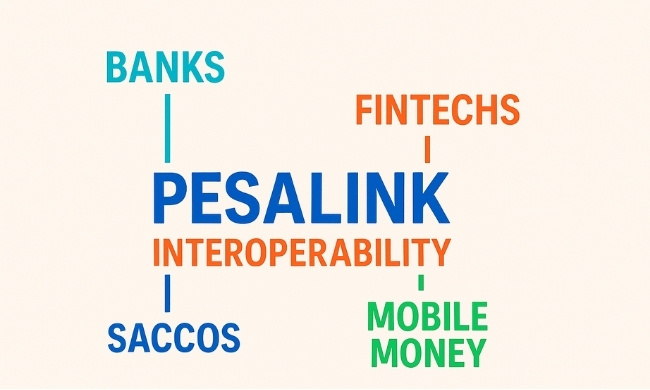
Pesalink is not just a payment network anymore; it has evolved into the backbone of Kenya’s financial ecosystem. This transformation is marked by strategic partnerships that have redefined how money circulates across the country. From cross-border remittances to the integration of Savings and Credit Cooperative Organizations (SACCOs), Pesalink’s collaborations are a testament to its vision: to make digital payments fast, affordable, and accessible to everyone.
Breaking Down the Borders: NALA and Equity Bank
In September 2025, Pesalink joined forces with Tanzanian fintech NALA and Equity Bank to revolutionize cross-border payments into Kenya. This partnership simplifies and accelerates diaspora remittances by routing them through Pesalink’s instant payment network, with Equity Bank handling settlements. This means recipients in Kenya can receive funds in real-time, directly into their mobile wallets or bank accounts.
This collaboration is pivotal, considering Kenya’s remittance inflows surged by 18% in 2024, reaching $4.94 billion, making it the country’s second-largest source of foreign exchange after agricultural exports. The majority of these remittances stem from regions like the US, UK, and Europe, where NALA has established a strong user base. Instead of navigating the lengthy licensing procedures with the Central Bank of Kenya, NALA smartly leveraged Pesalink and Equity Bank’s existing infrastructure, bypassing regulatory hurdles and entering one of Africa’s most competitive payment corridors.
Samuel Ireri, Equity Bank’s group head of international banking and payments, emphasized that the partnership is more than a technical integration; it’s a strategic initiative to drive inclusive economic growth.
Empowering SMEs: TendePay Integration
Shortly after the NALA partnership, Pesalink announced a significant collaboration with TendePay, a Kenyan spend management platform. This integration allows businesses to process instant payments up to KES 999,999 at any time. TendePay connects to Pesalink’s extensive infrastructure, which includes over 80 banks, SACCOs, telecommunications companies, and fintech providers across Kenya.
For small and medium enterprises (SMEs), this partnership is transformative. Businesses can now manage payroll, supplier payments, utility bills, and customer collections through a single platform, with transactions settling instantly, 24/7. The platform accepts both bank transfers via Pesalink and M-Pesa, enabling even informal businesses without bank accounts to participate.
TendePay CEO Abel Masai highlighted the partnership’s significance, stating, “This partnership reflects our transformation into a full spend management platform. With Pesalink’s trusted infrastructure, we’re providing businesses with a reliable, secure, and affordable tool to manage every payment, whether large or small, at any time.”
This collaboration is timely, as Kenya’s SMEs employ nearly 14.9 million people and contribute roughly 40% of the country’s GDP. However, traditional financial services often fail to reach them. By lowering costs and simplifying payments, Pesalink and TendePay are directly addressing this gap.
Bringing SACCOs Into the Digital Age: Unaitas
In November 2025, Pesalink partnered with Unaitas SACCO, one of the first SACCOs in Kenya to integrate with the instant payment network. This collaboration is crucial because SACCOs are a significant economic force in Kenya, comprising over 14 million members and holding more than KES 800 billion in deposits.
By integrating with Pesalink, Unaitas transformed how its members manage their finances, enabling real-time payments, simplifying transactions, and accessing advanced tools like Pesalink Bulk for payroll disbursements and Pesalink Pay for merchant settlements. Martin Muhoho, Unaitas CEO, succinctly stated, “Harnessing Pesalink means a faster, more convenient, and secure way for our members to transact instantly.”
The partnership is not solely about technology; it’s about setting a blueprint for the entire cooperative movement. Unaitas is now aiding smaller SACCOs in exploring integration, demonstrating how inclusion can be achieved through interoperability.
Making Business Payments Seamless: Paystack and Cellulant
Pesalink’s expansion efforts didn’t stop at remittances and SACCOs. In October 2025, the platform partnered with Paystack, allowing Kenyan businesses to accept instant bank-to-bank payments 24/7. Through Paystack Checkout or API, customers can pay directly from their bank accounts without needing cards. Pesalink supports transactions up to KES 999,999, making it suitable for both small purchases and significant B2B transactions.
This integration offers businesses several advantages:
- Broaden Customer Reach: Accommodate customers who prefer paying from bank accounts.
- Secure High-value Transactions: Handle large transactions securely.
- Reduce Fraud Risk: Utilize direct bank-to-bank transfers to minimize fraud.
Earlier, in September, Pesalink announced a similar partnership with Cellulant. By integrating Cellulant’s Tingg payment platform with Pesalink’s network, the partnership enables millions of consumers to pay businesses directly from their bank accounts. Michael Muriuki, VP Group Innovation and Software Engineering at Cellulant, expressed the vision: “This partnership demonstrates our commitment to improving the everyday transaction experience for businesses and their customers.”
Global Giants Join the Game: Mastercard Partnership
Pesalink’s ambition isn’t limited to local collaborations. In October 2025, the platform signed a Memorandum of Understanding with Mastercard, one of the world’s largest payment networks. Under this agreement, Pesalink will leverage Mastercard’s technology, expertise, partnerships, and cyber intelligence solutions to enhance its digital payments capabilities.
This collaboration extends beyond mere payment processing. Mastercard provides advanced cybersecurity, fraud detection, and technical advisory support to bolster Pesalink’s infrastructure. The partnership aims to create digital-first payment solutions for various use cases, including direct-to-consumer propositions through apps and USSD, agent banking, business payments, government collections and disbursements, and both face-to-face and remote transactions.
Gituku Kirika, Pesalink CEO, highlighted the partnership’s significance: “This collaboration with Mastercard is pivotal in providing millions of Kenyans with financial solutions that meet their needs, furthering our goal to accelerate the adoption and usage of digital payments in the country.”
Shehryar Ali, Mastercard Country Manager for East Africa, added, “We are very excited to collaborate with Pesalink to lead the transition to a more inclusive digital payments system—and to do it in a way that helps society at large.”
The agreement indicates that international payment giants recognize Pesalink as critical infrastructure worth building on rather than competing against.
The Bigger Picture: A Fintech Programme
In October 2025, Pesalink unveiled the Pesalink Fintech Programme—an initiative designed to help fintechs build, scale, and deliver financial services more efficiently. The programme offers direct access to Pesalink’s secure APIs, settlement network, and shared infrastructure, with three core components:
- Engagement with fintechs and settlement banks
- Development of new use cases
- Tools to support innovation, including a Pesalink Sandbox for testing
Pesalink has already onboarded over 26 fintech partners and established preferential access and pricing with selected settlement banks.
Beyond instant account-to-account payments, the programme introduces two expanded use cases:
- BulkPay enables businesses and fintechs to send numerous payments instantly through a single API or web interface, ideal for salaries, supplier payouts, refunds, or loan disbursements.
- PesalinkPay allows merchants to receive account-to-account payments from customers, enhancing the checkout experience with instant transactions and payment notifications.
Gituku Kirika, IPSL CEO, described this as a landmark moment: “We’re moving beyond enabling transfers to enabling innovation. The Fintech Programme gives the sector freedom to experiment, test, and connect directly with our rails.”
Why This Matters
In 2024, Pesalink processed over KES 1.1 trillion in transactions, with 8.2 million instant transactions at an average ticket size of KES 135,236. But these figures only scratch the surface of what’s unfolding.
Pesalink is ushering in a fundamental shift in Kenya’s payment infrastructure. It is positioning itself as the neutral, shared backbone that connects banks, fintechs, SACCOs, and digital platforms. The partnerships with NALA, TendePay, Unaitas, Paystack, and Cellulant are not isolated agreements but foundational blocks for a truly national fast payment system that serves everyone.
As Kenya’s digital payments market is projected to grow at 14.1% annually, and with the country ranked among Africa’s fastest-advancing real-time payments ecosystems, Pesalink’s open-access model sets a benchmark for sustainable growth and inclusive innovation.
The message is clear: the future of payments in Kenya is not about walled gardens. It’s about interoperability, collaboration, and shared infrastructure that makes digital finance accessible to all.
What do you think about Pesalink’s partnership strategy? Are you using any of these integrated services in your business? Share your experience in the comments.